Teaching History to the Modern Child

I always liked history class. I still read a lot of biographies on historical figures, watch documentaires about histical events, and listen to history focused podcasts from time to time. My kids are still too young to have actual histry class in school, but my oldest did start learning about some local history in social studies. Next stop, Ken Burns’ Civil War. Well, maybe not, but history is more than a matter of the past. It teaches critical thinking, empathy, and perspective of the past that will shape our future. Unfortunately for children however, history lessons can sometimes feel boring and over their heads. By adapting the teaching approach according to each child’s developmental stage we can encourage an interest in history. Here’s a breakdown by age groups in order to identify strategies that will keep them engaged and curious.

Ages 5-7: The Storytellers

Make It Fun with Storytelling

Children love telling tales (real or imagined), making storytelling an effective medium for conveying history to them. Make historical events come alive through engaging narratives replete with adventures, heroes, and interesting characters. Picture books can be an engaging way of bringing historical figures and events more interesting for kids. Their illustrations make history more accessible while their tales make significant moments more captivating. You might also consider writing your own simple stories that highlight parts of history that are most interesting or relevant to you. By creating engaging narratives about history, this approach not only captures their attention but also helps them connect emotionally with it, increasing curiosity and encouraging learning. We can spark their passion for this important subject that will resonate in their imaginations.

Interactive Learning

Engaging children in historical topics through interactive activities is one way to increase their engagement. Engage students by holding dress-up days where they wear costumes of historical figures from their preferred period, giving them a way to connect to history while sparking dialogue about each of them. Bonus points if you put ask them rediculous questions and challenge them not to break character. Hands-on projects such as creating timelines or curating museum exhibits using drawings and crafts can enhance their understanding of historical events while keeping it fun for students. These activities make learning enjoyable while also encouraging collaboration and creativity, helping children establish personal ties to history that foster lasting appreciation of its subject matter. By mixing fun with education, we can create memorable learning experiences that nurture curiosity about history.

Use Multimedia

Remember when the teacher would roll the TV into the classroom? Times change but what gets kids excited about learning does’t. Utilizing videos, cartoons and animations to share historical events with children can make learning more relatable and engaging for them. Shows like Liberty’s Kids provide a compelling blend of entertainment and education introducing young audiences to significant events and figures from history through dynamic storytelling techniques that captivate children’s attention while piquing curiosity about when and where these events took place. Taking this multifaceted approach not only makes history more accessible but also promotes further inquiry about it, sparking deeper interest for further study.

Ages 8-10: The Explorers

Field Trips

Children ages 8-10 are eager for new experiences that spark their curiosity. Arranging trips to historical sites, museums or live reenactments gives them an immersive look into history. Participating in events such as colonial fairs or Civil War reenactments provides a unique way of engaging with historical narratives. Such experiences offer insights that traditional books cannot fully convey, and make or good people watching. It is a special breed of person who takes part in Civil War reenactments. Anyway, by placing themselves in the shoes of their ancestors, children gain a deeper appreciation for history while awakening their curiosity about learning and exploration. Engaging children in such trips through an engaging curriculum can transform history from mere facts into vivid tales that resonate with young minds.

Creativity-Driven Projects

Getting hands on with children in creating their own history projects enables them to delve into topics that pique their interest, such as notable inventions or cultural practices. Kids can demonstrate their findings and share new knowledge through presentations, written reports or even short videos. This approach allows children to take ownership over their learning while also helping them discover personal interests within history. Active research and presentation help children explore historical narratives more deeply. Through such projects, children make history tangible and accessible, opening up endless avenues for further discovery and investigation.

History Through Technology

At this age, it’s important that children experience history through technology in an engaging and captivating way. While my generation had the View-Master, kids today can use virtual reality experiences to bring history alive, taking them on thrilling virtual trips through ancient Rome or Egypt’s pyramids and offering real life experience of significant events or places from history first-hand. By mixing learning with play, children may develop genuine interest in discovering what has gone before them. Reinforcing that history isn’t just something boring they need to memorize, rather it offers them endless adventures.

Ages 11-13: The Critical Thinkers

Discuss Relevant Issues

As children reach 11-13, they begin to think critically and understand complex social issues, so it is important that conversations around relevant historical topics such as civil rights, social justice and global conflicts occur. Discussions between students can help them make connections between historical events and current issues, building empathy and awareness. Guided debates, group projects or writing assignments provide them a forum in which to express their thoughts and opinions freely. By exploring various perspectives and understanding what motivated historical events, children of this age group will not only develop stronger analytical skills, but also gain a more thorough knowledge of the world they inhabit, becoming informed citizens in future years.

Project-Based Learning

Engaging middle schoolers in research projects allows for deeper examination of key topics such as the impact of the Industrial Revolution on contemporary society. These projects promote important skills development such as research methodology, effective writing and presentation techniques. By exploring historical events and their long-term effects, students learn to synthesize information efficiently and articulate it clearly. Academic assignments that foster curiosity and critical thinking encourage academic growth while inspiring students to make connections between past and present events. Engaging in these research endeavors empowers them to become informed individuals who can contribute significantly to discussions about society and history.

Use Literature and Media

Suggesting historical novels and movies as educational material to middle schoolers can lead to lively conversations about important historical themes. Books such as The Book Thief and Blood on the River can provide readers with emotional connections to significant historical events, and movies like Forrest Gump and Hamilton, but a uniqe spin on how we can view history. These narratives offer engaging contexts for exploring wider themes like survival, bravery and war’s effects. Engaging with these stories encourages empathy and understanding while drawing parallels between past and present events. Through discussions and reflections about such works, students can develop an appreciation of history’s relevance in today’s society.

Ages 14-18: The Analysts

Get It Right from the First Day at School

High school students need to set the appropriate atmosphere from day one of school in order to create an ideal learning environment. Encourage them to establish good study habits and organizational capabilities early. This will be “do as I say, not as I do for me”, as I was never really one to study. But try creating a dedicated study space, utilizing planners for assignment management, and developing a routine that balances schoolwork with extracurricular activities. Didn’t work for me, but maybe it will work for your my kids or yours. Establishing a growth mindset enables students to see challenges as opportunities rather than barriers to learning, so introduce students early to this important concept using first day of school activities for high school US history. Help your child navigate their way towards independence and responsibility with ease so that you’re better positioned for navigating both education and career success.

Challenge with Complexity

Teenagers possess both an uncanny ability to be total weirdos, and to understand complex systems and appreciate subtleties. Therefore, it is vital that we introduce them to historiography (which examines how history is recorded and interpreted) early. Engage students in conversations that explore how different perspectives and time periods can lead to differing interpretations of historical events, strengthening both their critical thinking skills as well as encouraging them to critically analyze sources and narratives more closely. This exploration will not only increase critical thinking skills but will also hone scrutiny of sources and narratives more closely. By developing an understanding of historiography, students will gain a more informed and analytical approach to history, realizing narratives are often affected by context, bias and intention, providing them with invaluable tools for academic and personal growth.

Engaging Older Students in Current Events

Engaging older students in current issues is vital to deepening their understanding of history and current events. Doing this requires encouraging them to make connections between historical events and modern issues and drawing parallels between historical issues and contemporary issues, for bettering understanding. Discussions around social justice, human rights, and political systems can provide invaluable insight into how past events have had an effect on present-day challenges. By exploring these connections, students can better comprehend the complexity of today’s landscape and recognize history’s place in addressing contemporary societal concerns. Engaging students in history helps foster critical thinking while instilling a sense of responsibility towards addressing injustices and advocating for change within their communities. Furthermore, linking the past with the present equips students to become informed citizens who understand its influence on shaping the future.

Support Independent Research

Promoting independent research among high school students is key to increasing enthusiasm in history and developing deep understanding and engagement of the subject matter. By investigating topics that excite them, students can deepen their knowledge and engagement of each subject area they explore. There are ample opportunities for expression within schools: writing articles for school newspapers or contributing blogs, presenting findings at school events, or participating in history fairs to showcase research. History fairs also allow students to display their knowledge with their peers, providing invaluable opportunities to showcase research findings and share insights with each other. All these activities not only foster critical thinking skills but also empower them to take ownership over their learning, helping foster an enduring passion for historical study that extends far beyond classroom walls.

Right now my kids are still little and are still soaking up information like a sponge. While it is probably too early to teach them about the terror of slavery or the horrors of war, there is still plenty of other non-blood soaked history to lessons to start them off with. Of course, to them the years of my childhood seems like history, so if nothing else I can show them my old baby pictures as anchient artifacts from a far off time period of the 1980s.


Learning From a Trip to Urgent Care

When I think of classic father and son bonding moments, a few typical ones spring to mind. Playing catch in the yard, going camping, watching football, going to urgent care to get a foreign object removed from somebody’s ear. Oh, did you not have medically extracting an object from your son’s head on your male bonding bingo card?

A trip to urgent care or the emergency room is inevitable when you have kids. Something is going to happen. It just will. While this was not our family’s first experience taking a kid to urgent care, it was mine. When my oldest daughter was younger she fell off a chair and hit her head on the corner of coffee table. I was good enough in the moment to stop the bleeding, but she asked for mom to take to the doctor. I suppose it was my turn, so getting whatever was in my son’s ear out was all me.

I don’t know how long it was in there. Maybe an hour or so, or maybe all day. It was brought to our attention when his older sister, properly filing her role as middle child, tattled on him right before bedtime that he said he put something in his year. Every so often the tattling child really does come in handy. While I couldn’t care less who took what Lego from who, it really is helpful to have somebody on the inside when one of the three kids is plotting to do something stupid or have caused bodily harm.

My first instinct was to take a DIY approach. Every parent has their strengths and weaknesses, and removing things from my children has definitely been a strength of mine over the years. But who would have thought the tick in my daughter’s head would be much more difficult than whatever it was that my son shoved in his ear. At this point, it was unidentified. According to him, it was a “white ball.” While my son may have a pretty sizable noggin, I was pretty sure he didn’t shove a golf ball or a baseball in there – the only things in the house that I could think of that would be a white ball. I took a look to see what was in there and did see a white obstruction.

While I got the tweezers, my wife started looking up how to get things out of a kid’s ear. The object was right there to be grabbed, not shoved completely far back in his ear, so surely I could tweeze it on out of there. However, no luck. A few tries and I think all I did was push it back a little further. Right as I was giving up, my wife announced that the first step in object removal was to not try to get it out with tweezers. Well, shit.

Father and son waiting at urgent care
Waiting at urgent care. He was more interested in why the building had a cafeteria than he was about why he had something in his ear.

To urgent care we went. In pretty good spirits I must say. The little guy wasn’t scared or in pain, more curious about what was going to happen. Luckily there was nobody else there so the wait was short and we were back in the exam room quickly. Upon telling them that my son shoved something in his left ear and we weren’t sure what, I simultaneously felt that this was probably something they hear all the time, and that they also judge my parenting ability. Kids shove stuff in themselves, it happens. But I think it was the not knowing what it was that bothered me. Clearly I wasn’t paying any attention to him when it happened. A kid shoves a pea up their nose at dinner, that’s kids being kids. An unsupervised four year-old shoves some random object he found on the floor in his ear, that’s half-ass parenting. Poor vacuuming to say the least.

Armed with no more detail than unidentified white object in his left year, the medical experts sprung into action and examined his right ear. At first I thought maybe they were looking at both just to be thorough.

“I don’t see anything in there,” the assistant said.

“Left ear,” I reminded her. Our less than stellar start didn’t get much better.

They tried fancier tweezers than I had at home, but with the same results. They tried a tiny little pressure washer attachment for a squirt bottle, which moved it around but not out. They tried the less than highly scientific approach of a dollop of glue on the end of a little slick. I forgot to ask my wife where glue on a stick ranked on the list of things to do or not do at home to get something out an ear. Probably not high.

After about half hour of the doctor trying to get it out while my son stared daggers through her, they gave up. I have to say, my son did great. He sat still, he didn’t flinch or cry or tell them to get the glue on a stick away from him. This created a weird sense of pride in me. He behaved exactly the way I’d want him to. If this was a normal trip to the doctors, we would absolutely stop at the bakery on the way home for a doughnut. However, the little dingus did this to himself. No bonus points for behaving well in the annoying situation you put yourself in. His only reward was an appointment with an ear, nose, and throat specialist the next day. I let him know I was proud of how he behaved and that he was very brave, but also made sure he knew that he should never put anything in his ear again. I now realize that I didn’t mention anything about noses. I wonder if I can preemptively get on the ENT’s schedule?

We went home discouraged and a little confused. Is it safe for him to go to bed with something in his ear? What if he rolls around in his sleep and it sinks deeper in there? What if he itches something and pushes it farther in and it would just be in there forever? Someday he’ll be an old man telling tales of his trick ear that still has something in it. Like an old war vet with shrapnel in his leg, but way less honorable and way more doofusy.

My wife took him to his second appointment, but I heard it was pretty much the same. Multiple attempts and multiple tools, but they must have had better tools because this time they were successful. They removed a little broken of piece of styrofoam from his ear. A fragment from a larger piece my kids were drawing on and playing with a few weeks ago. Please excuse my while I go vacuum my basement.

This time his behavior was rewarded. One doctors appointment was enough to teach him about the repercussions of his decisions. Good behavior at a second appointment warranted a treat. He was brave through the whole thing, and didn’t seem too upset about having to spend the night with debris in his ear. Seems like a good balance of using bad choices as teachable moments and using positive reinforcement to encourage more good. The yin and the yang of parenting in one little ear. Hopefully it won’t immediately go out the other.

My Kids Will Know a World of AI

I have to say, I am incredibly sceptical of the real-world impact AI will have. I’m sure there will be big advancements for tech companies, but not sure how it will actually apply for the average person’s everyday life. Until Alexa can understand me when I tell her to never play any Taylor Swifts songs ever again no matter how many times a little girl’s voice asks, I’m not impressed. But perhaps this is how the older generation felt about the internet. So regardless of how I feel about it or much (or maybe more accurately how little) I’ll use it, my kids will live in a world where AI is more present than future.

Personalization in Content Consumption

Gone are the days of being at the mercy of the TV or the radio for what you want to consume. My kids can’t comprehend the idea that you can’t always watch whatever episode of whatever show you want. We’ve not had cable since before they were born, so streaming is all thye know. AI-powered algorithms now deliver personalized recommendations based on users’ viewing habits and preferences. Every streaming service uses sophisticated machine learning algorithms to track user behavior, making suggestions that appear almost telepathic in nature. They say it helps to increase viewer satisfaction, but the main strategy behind this is to keep audiences engaged for longer. When viewers feel like content platforms understand their tastes more, binge watching becomes much more likely. These platforms’ algorithms continue to adapt accordingly, providing feedback loops which constantly refine user experiences while constantly evolving their algorithms make users more and more likely to keep watching. I have to say that my kid’s decisions to keep watching “just one more” Bluey is only partially because it is the best kids show out there. The other part is that Disney+ keeps feeding them another one.

AI in Music Production

I have a dad’s taste in music– which is to say music that existed 25 or more years before AI existed. While it might not be my cup of tea, the musical times they are a changin’. Musicians are using AI-powered software to compose, analyze trends and even produce tracks. AI can scour through thousands of songs to identify successful patterns in melody, rhythm and harmony and serve as a source of inspiration for artists. Traditionalists (like me) may scoff at this concept, but consider this: AI tools such as AIVA (Artificial Intelligence Virtual Artist) have produced works which are nearly indistinguishable from human-crafted works. In addition, AI can assist with mastering tracks, making production more efficient and accessible, especially to up-and-coming musicians. Again, I’m sceptical here until AI can prove it can make something better than “Free Bird.”

Gaming and Immersive Experiences

I am of a generation that had their young minds blown by the original Super Mario Bros. The fact that Mario 3 is the best video game ever made is a hill I’ll die on. However, technology has advanced, and Non-player characters (NPCs) now respond more intelligently, with scripted AI interactions for dynamic interactions that enhance realism and make gameplay more captivating than ever. Furthermore, AI is even capable of creating entire environments and levels within games, giving developers time to focus on refining gameplay mechanics and storytelling. As a result of all this innovation, gamers enjoy rich, elaborate worlds that evolve over time while testing their skills against complex environments that continue to challenge them and draw them back for more.

AI in Sports and Betting

Watching game tape on a VCR and rewinding and rewatching your plays over and over again to try to pick up some little advantage seems so antiquated now. Coaches and athletes now utilize AI analytics to analyze performance data, fine-tune strategies and enhance training regimens through analysis. Artificial Intelligence-powered predictive analytics can analyze player statistics, team dynamics, and even weather conditions in order to more accurately anticipate outcomes. Not only has this led to a whole bunch of new stats that don’t fit neatly on the back of a baseball card (WAR is made up and stupid in my opinion), but has also led to an explosion of sophisticated sports betting platforms utilizing machine learning algorithms and providing real-time odds and insights. As betters have become more knowledgeable, the betting landscape has transformed into an AI sports picks market where enthusiasts can make informed decisions using data-driven AI analysis rather than simple intuition. While this has yet to help me hit a college football parlay, it is a big jump from getting a hot tip from your bookie.

Future of AI in Parenthood

As much as I hope it doesn’t happen, I know I’ll end up looking like Abe Simpson on this one – just an old man yelling at a cloud and telling young folks all about how it was back when I was young and how that it was so much better back then. Every generation goes through it, but as all technology – not just AI – advances faster and faster, that old man feeling comes sooner and sooner. I’m not yet 40 and there are things from my not so distant younger years that are literally in museums. So as my kids grow up in this world, at what point will the technology they use on their own be past my comprehension? High school? Middle school? Next semester? It isn’t very likely that I won’t be able to help my kids with their homework because I don’t know the answers. It is extremely likely that I won’t be able to help them with homework because I won’t know how to use the technology they are doing it on.

Grounding My Kids for the First Time

When I first started thinking about what kind of parent I thought I’d be, there were a couple things I never thought I would do. Send my kids to a “time out,” ground them, or reply with, “Hi Thirsty, I’m Dad,” when they told me they were thirsty. I had a pretty good run, but I’ve officially crossed one of those off the list. My kids were finally bad enough that I had to ground them. All three of them. At the same time.

Working from home, while providing an element of freedom, also brings its own set of challenges. Especially in the summer when the kids are home all day. I get that it is hard for them when I’m in a meeting, needing to be quiet and not being able to get any of my attention. But I also know that they really like it when I have longer meetings because they know I’ll let them just watch a movie. Well, a few weeks ago whatever they were watching while I was in a meeting wasn’t holding their attention, so they turned their attention to disrupting me.

Remember back at the start of Covid when there were all those funny videos when a kid would wander through the background of some CEO’s conference call? Well, the “aww how cute” of that has really worn off. Working from home isn’t some kind of odd novelty that we are all making due and getting by with. It is business as normal now. And much like it wouldn’t be very normal if your kid walked into your office and threw a stuffed animal at you in the middle of a presentation to an important client, it is just as not normal for a kid to hurl whatever they could get their mitts on at you while on a Zoom call. So disrespectful story short, my kids were animals while I was in a meeting, and there were consequences and repercussions.

Inside Out Quote - The foot is down.

I thought it would be harder, but the decision to ground them came easy. No dessert or TV for the rest of week sprung to mind like it had been waiting there for years, tucked behind “get that out of your mouth” just waiting for its moment to shine. How quickly I abandoned the idea that I’d never be a parent who grounds my kids. I realized it in the moment that I was doing it, compromising the kind of parent I thought I wanted to be. But it didn’t upset me initially, it was what it was. What upset me more was that my kids were now the kids of kids who got grounded.

Unless I have completely repressed the memory, I’m pretty sure I never got grounded when I was kid. Sent to my room, sure. Not given ice cream as a one-off punishment, yeah. But never a sweeping multi-day grounding. Was I just that well-behaved of a child? Or did my parents look past behavior that other parents would have grounded me for? I’m going to go ahead and assume I was exceptionally well-behaved. Or at least slightly above averagely well-behaved. So how was I not able to instill that same kind of behavior in my kids? An almost knee-jerk reaction when my kids misbehave is to say something like “you know better” or “we taught you better than that.” But do they, and did we?

I’m pretty sure I’ve done a good job of teaching them how to behave. Or at least correcting them in teachable moments when they don’t. Well, if I didn’t before I sure did now. My younger two kids also learned an important lesson about not doing something just because your older sister said to.

Yeah, kids will be kids and do stupid stuff. Even if they truly do know better, some thought will pop into their brains and they just don’t have the impulse control or reasoning to stop themselves from acting on it. I assume this is how most Blippy gets watched. But when it is repeated, sustained bad behavior among all three kids simultaneously? More than impulse control, that is mob mentality. I know exactly what happened. My oldest daughter started acting out first, didn’t get the response she wanted, so she convinced her younger brother and sister to come down and try to bother me. Surely I couldn’t get mad and punish all of them, right? Fools.

In the moment I took no pity on them. As soon as my meeting mercifully came to an end I dispatched them to their rooms with great vengeance and furious anger. That temporary detention was not enough, and the decision was made to ground them. Then I did start to feel a bit of pity for my younger two kids. Evie, my six year-old daughter, clearly got it. She knew she was in trouble. She knew how she acted wasn’t right. She came right out and ratted on her older sister that she was the ring leader of it. The punishment was set, I couldn’t go back on it now, and I wasn’t going to let one of them slide. Much like the coach who makes the whole team run laps when one player does something stupid, I needed to handout the punishment across the board. Even if they weren’t all as actively involved, they were all complicit. Is it fair? Maybe not, but teaching your kids that life isn’t fair is important too.Though as the days went by and Evie clearly displayed her contrition, I did sneak her a cookie. I can’t stay mad at that little peanut.

However, as the week went on I found myself staying mad at myself. Well, maybe not mad, but disappointed. On one hand I need to deliver the message to my kids that how they behave toward other people (especially their father) matters. But on the other hand, did I send them a message that my ability to focus on work is more important than focusing on them? This has been someting that I’ve struggled with ever since I started working from home. I wonder what lesson will resonate with them more. That, no, you shouldn’t throw pieces of paper at your dad while he is on a conference call, or that no, dad doesn’t have time to pay attention to you?

Since the grounding, they have not come anywhere close to behaving that badly while I’m working. They have pretty much stayed away, and when I do tell them I have a meeting they get to another part of the house pretty quickly. I guess it worked. Now that they know what it is it, grounding is also a tangable threat to punish future bad behavior, so maybe once will be enough. We’ll have to check back when they are three teenagers.

Would I ground them again if I had to? Yes. But I would definitly make sure to take stock of what I know I’ve taught them before. Something that I’ve at least given one warning about. One thing I’ve learned is that I can’t expect behavior out of my kids because acting that way is common sense. They have no common sense. At all. Unfortunately, sense often comes from struggle. I guess at least the struggle this time was a grounding from a parent and not a harsher situation that the world out there can throw them. I suppose that is parenting in a nutshell, being a little bit of jerk to your kids so they can be prepared for the much, much larger jerk that is the world.

Simple Tips for Furgal Home Buying

Every time a house comes up for sale in my neighborhood, I can’t help but look it up to see what they are asking for. When I see how the housing market has changed from the time we bought our house to now, it is always very tempting to see what we could get for ours. As much as I’d like to turn a nice profit on my investment, I’d then be in the position of needing to find a new house. We are staying where we are for the foreseeable future, but it never hurts to have a plan. If you’re in the postion of buying a house but also want to save as much money on the whole process as you can, here are a few things you should definitely know.

1. Say Yes to Less

Before you dive headfirst into the property pool, it’s good to take a step back. And also maybe don’t get a house with an actual pool. Do you really need that four-bedroom palace for your cat and your succulent collection? Downsizing your space ambitions can drastically reduce your costs not just upfront but in ongoing maintenance and utilities, although it can be tricky if you have kids and/or work from home, so give it some thought. Smaller homes have their perks: less cleaning, less spending, and more money for taco Tuesdays.

2. Foreclosure Fortunes

You might also want to consider buying a foreclosure. Yes, it sounds a bit like scavenging, but with a strategy. Foreclosed homes can be a bargain bin of opportunities if you’re willing to put in some elbow grease. Just remember, it’s like adopting a pet from a shelter; they might need a bit more care and feeding to bring them back to glory. Hopefully less doodoo to clean up though.

3. Fixer-Upper Flair

If you’ve ever fantasized about wielding a hammer and shouting, “I can fix it!”, then you play into the sterotype that dad is handy. If you actually can fix it, a fixer-upper might be your budget-friendly ticket. Purchase a home that needs a little TLC, and invest in renovations as you go. It’s often cheaper than buying a move-in-ready mansion, and you get the added bragging rights of transforming a frog into a prince.

4. Real Estate Attorney vs. Agent

Now, here’s a novel idea: consider using a real estate attorney instead of an agent when you’re ready to do the deed—or deeds, as it were. While agents are great for finding you the right home and negotiating deals, an attorney can handle the closing processes and ensure everything is legal and tidy for often less dough. This way, you cut out commission costs and get straight to the legal nitty-gritty.

5. Government Grabs

Look into government incentives and loans, especially if you’re a first-time buyer. Programs like FHA loans can offer lower down payments and are friendlier to those of us whose credit scores aren’t brag-worthy. Plus, who doesn’t want to say they finagled a deal with the government to score a home?

6. Off-Season Shopping

Buy during the off-season. Winter, especially around the holidays, can be a goldmine. Sellers are fewer, buyers are preoccupied with decking halls, and you might just snag a deal from a seller desperate to close before the New Year. Bonus: moving in the cold means fewer sweat stains on your favorite moving shirt.

7. The Long Game

Consider the long-term. Choosing a home that holds value or is in a budding area can mean better resale value. Think of it as the slow cooker of investment strategies: set it, forget it, and let it simmer into a lucrative stew of future profits.

As you can see, even buying a home can be made more frugal if you really try!

When the Going Gets Tough, Get Together

When you are in a relationship and then add some kids to it, you are bound to experience a number of difficult experiences together. In a way, you should expect this to happen and be prepared to take them in stride, as these are the times that can bring people together more closely. But there is no doubt that you are going to need to learn how to manage those occasions, and that you will need to do it as a couple, so you can be sure that you are going to get closer and not farther apart as a result.

I don’t claim to be an expert, but I’ll take a look at some of the things you can do to improve this process of working through challenges, so you are more likely to get through the toughest experiences more easily. Let’s take a look at what you might want to bear in mind here.

Communicate More

Something pretty simple, yet often overlooked is making a point of communicating more with your partner. If you asked my wife she would probably roll her eyes at me saying this. I guess we can file this under doing as I say not as I do, which is always a pretty crappy way to give advice. So I’ll count this as a reminder to myself as well. If you are not communicating properly, then you can’t really expect to know what’s going on fully for the other person, and before you know it you are going to be in a difficult position of having to try and figure it out instead.

Just talking about how you are feeling, however, could make a world of difference. So you should make sure that you are both doing this, although it might require that you learn how to do it and it might take some practice. Nonetheless, it’s going to help a lot and you will find that it’s definitely worth thinking about.

Don’t be Afraid to Get Outside Help

There are many times when you are going to benefit from getting some outside help, and you should never be ashamed to ask for it when that becomes necessary. My wife and I have started taking our daughter to a therapist. I’d say the results thus far have been mixed, but we are giving it a shot. And that is worth something, right? Even beyond therapy, there are many kinds of help that you might benefit from as a couple. It is going to depend on the situation, but there will be times when you need professionals from a hospital or medical center, people you can give you anything from advice on healthy diets or maybe even abortion clinic information, and it’s going to be vital that you can get that help.

So you need to be comfortable, as a couple, with asking for help from people, and if you can do that, it’s going to make a world of difference. Not to paint with broad strokes, but it has been said that men have a hard time asking for help, so make sure you’re helping each other help each other.

Be Patient

Throughout all of it, the more patient you can be with one another (and your kids), the better that is going to be for you both and for the relationship itself. If you struggle with this and you lose your temper, that’s okay, it happens to everyone. There is also the flip side of sometimes being too patient. But if that is happening all the time, that can be a problem, and before you know it you might find that you are struggling to work together as well as you could.

So, be patient and see what you can do to work together more and more. Sometimes the situation is going to resolve itself in some way or another, and in some sense all you really need to do is wait it out. So bear that in mind and you may find it is a little easier to get through it together.

Spend Quality Time Together

Even when difficult things are going on, try to find the time together that you need in order to feel like a couple. Even if the best you can do is an our of semi-quit time between when the kids are in bed and you’re too tired to do anything. Once you have kids, you need to protect your own time or your kids will steal all of it before you even realize where it went. Don’t forget your life is still your live, and your role of partner is just as importnat as your role of parent.

Teach Your Kids How to Eat

One thing I didn’t expect to have to teach my kids was how to eat. I guess I figured that since it is the first and only thing they know how to do when they are born, that it is overall a pretty instinctual process. Well, it’s not. A kid’s eating instincts are limited to getting a thing in (or at least pretty near) to their mouth, and chewing. Which, yeah, that will get the job done in terms of getting the food into the body. But there is a big difference in how you get into the body, say, soup and ribs.

I wouldn’t say my kids are any messier eaters than any other kids. Which is to say they are pretty messy eaters. At any given moment there is probably chocolate on my son’s face. I’m not sure if that says more about his eating habits or my cooking habits, but either way, a chocolate face is normal. A clean face is the exception. But beyond just being messy when they eat, they really do struggle with how to eat certain kinds food, and I have to blame myself. I was so focused on teaching them how to walk, talk, and read, I didn’t put in the effort to teach them how to consume a meal like normal human person. Doughnut by doughnut, teachable moments went by, and now my kids eat like weirdos.

How to Eat a Doughnut

The first time I noticed my kids’ inability to eat a food normally was seeing how they eat doughnuts. They will occasionally go for a Long John (custard filled, not cream. They may not know how to eat but at least they have good taste), but for the most part they are suckers for the classic chocolate frosting with sprinkles. So what do they eat? The frosting and the sprinkles. They treat the bottom two thirds of the doughnut as if it were some kind of crust that is there to hold and discard after eating the good part. I have eaten many abandoned doughnut bottoms soggy with kid spit and stripped of its sugary toppings.

Clearly I should have showed them the proper way. Taught them to appreciate the exquisite combination of cake and frosting – truly one of life’s great pleasures. Or at least to just take a normal bite like a normal person. But I get it, they are in it for the frosting and sprinkles, and I can respect that. What I can’t respect is how my son eats a hot dog.

How to Eat a Hot Dog

Let me start by saying that this is not a judgement on toppings, more often, lack thereof. My two daughters eat theirs plain, and my son has his with just ketchup. He’s four, so he has plenty of time left to realize that mustard is the vastly superior condiment. Anyway, as I’ve mentioned before, my daughter previously awkwardly struggled with the right way to eat a hot dog, but she has gotten over that and now eats it in a way that doesn’t make it impossible for me to make eye contact with her at the dinner table. My son however, has applied the same top-down method he eats a doughnut with to his hot dogs.

The wrong way to eat a hot dog
This is not OK.

We recently went camping, so we naturally cooked hot dogs on the fire. His hot dog was cooked perfectly when I put it into his bun, but it all went downhill from there. We let him put his own ketchup on, so naturally he put about 800% too much on there. Then, he proceeded to eat the ketchup slathered top layer of dog. All the way from end to end. What kind of animal eats a hot dog like that? Pretty sure even an actual animal would bite the end of it. Unless its like a really small animal, like a chipmunk or something. My son is not a chipmunk. He’s a boy who was apparently never taught how to eat a hot dog. I prefer mustard on my hot dog, but clearly mine is topped with parental failure.

How to Eat a Taco

The wrong way to eat a taco
Taco Bottoms. The next big thing.

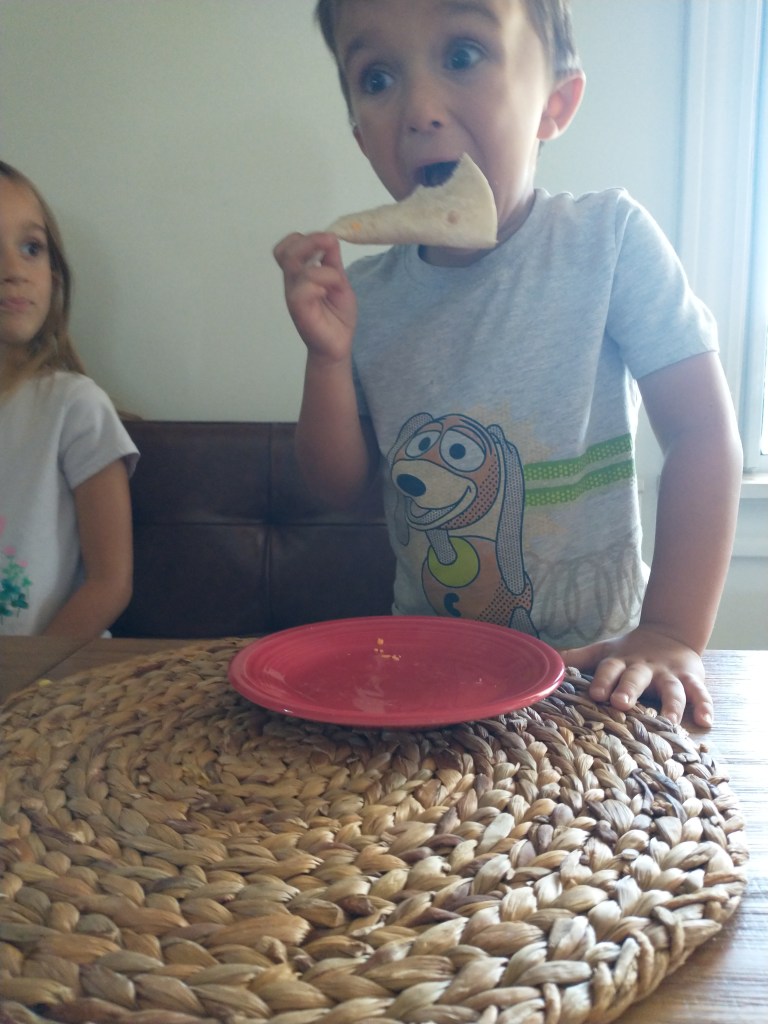
Top down strikes again. I mean, I get it, eating a taco is kind of unnatural. The way to hold it so stuff doesn’t fall out and the head tilt so you can get a good bite isn’t instinctual. But he has seen now literally everybody else he’s ever seen eat a taco eats a taco, right? I guess he wasn’t paying attention, because little fella chomped right in at the top of the curve. Ate down until he had a little cheese and peppers filled tortilla canoe. Maybe he has accidentally stumbled onto something. Could taco bottoms be the next muffin tops? I think so.

How to Eat Anything Filled with Cheese

A substantial amount of my kids’ diets consists of things with cheese. Naturally, there is grilled cheese, but they also take their tacos, quesadillas, omelettes, and pizza with just cheese. While they have started to expand their pizza toppings pallet, grilled cheese and plain cheese quesadillas are staple. But do they just bite them? Of course not. They are in the habit of peeling them open and eating the cheese out from the inside. I think I may have brought this on myself by trying to sneak some veggies in there from time to time, so now they’ll open them up to double check I’m not trying to smuggle anything healthy in their cheese and bread.

Little boy eating a taco
He’s eating all wrong, but at least he’s doing it with enthusiasm.

I get that there is a certain amount of enjoyment in revealing the cheesy innards of your food. However, they then proceed to pick the food apart, eat said cheesy innards, and once again leave an uneaten husk of a sandwich. I’ll crush a doughnut that has been scalped of its chocolaty top all day long, but I refuse to eat the carcass of what used to be a grilled cheese sandwich that my children’s picked clean of all the best bits.

They have started to age out of some of these eating habits. My oldest daughter eats pizza with toppings, bites her hot dog from one end to the other, and more often than not uses a fork to eat pasta. The more foods they are exposed to, they more they will know how to eat. It is currently cherry season, so they have probably had more cherries in the last few weeks then they’ve had in their lives up to this point. Learning how to eat something that small yet still with a pit in the middle has been a work in progress. My younger daughter eats it like a tiny peach. Nibbling around the equator until she reaches the center and leaving the fruit at the top and bottom. We’ll get there.

But how can I help them? Clearly modeling the behavior and thinking they would pick it up didn’t work. Perhaps we’ll have tutorials as part of meals with food’s they’ve not yet mastered. We took the time to show them how to use chop sticks or twirl spaghetti, I might as well take the time to breakdown the right way to eat a pea pod. If you’re wondering, they take the time to pop out each tiny little pea in the snap peas. I think they think they are really small edamame, which they actually do know how to eat. Seems we’ve tried so hard to expose our kids to different food than we had growing up, that we’ve skipped over the basics. To be safe I better get a dozen doughnuts every weekend for tutorials and quizzes. Seems the parentally responsible thing to do.

My Kids Are Thieves

Kids take stuff from you. Part of it is inherent to their existence and dependence on you. They take your time because they need a lot of attention. They take your money because it turns out that keeping another human alive, fed, and in shoes that fit is pretty expensive. I think I was pretty well prepared going into parenthood for my kids time and money from me. Getting prepared for that is part of the decision to have kids in the first place – kids take your time and money because they need it. What I wasn’t prepared for is how much of my personal belongings my kids take. Not because they need it, but because they are dirty little thieves.

It started with little stuff, and mostly arts and crafts related. Pens frequently go missing. Despite the fact my kids have their own complete sets of any possible writing utensil they could need – they want the pen on my desk. Any kind of note pad or Post-It note isn’t long for this world. Despite the fact that our house literally has a whole closet shelf full of every color of construction paper of the rainbow (plus a few colors that don’t naturally occur in nature), my kids are compelled to take any piece of paper I may need to use for a practical purpose and turn it into a ticket for their imaginary play at their imaginary school at which they are imaginary teachers. Guess I’ll just make this grocery list on the lid flap of this old cereal box.

Pens and paper is annoying but mostly harmless. My daughters often abscond with my wife’s shoes in games of dress-up, which means nothing to me, but it sure does bother her. My kids use my laptop to play games on and I discover it abandoned with a dead battery – but at least not broken. All these little petty thefts have become commonplace, but lately the boost has gotten bigger.

My wife had had the Snapshot driving tracker from Progressive in her van for the last few months, and the time was up and we took it out. It was brought inside and set on the kitchen counter. When I went to put in back in the box and send it back, it was gone. It is a requirement of the insurance agreement to send it back, otherwise, we will pay a fine. Little higher stakes than a Post-It note.

I asked my kids where it went, natrually nobody could remember. Both my daughters said my four year-old son had it last. I know he had to have done something with it, because he didn’t come right out and say he didn’t take it. He stuck to his “I don’t remember” defense. I tried to jog his memory. Checked where he plays, looked in his room, followed a hot tip from my daughter that he had it in a closet when they were playing hide and seek. Nothing. The more I questioned him, the more inconsistent his answers got:

  • He put it in his secret hiding spot (we checked what we claimed was his secret hiding spot, and it was not there)
  • He put it in a pipe in the back yard (we have no pipes in our backyard)
  • He thinks he might have taken it in the basement maybe
  • He threw it in the trash

Sadly, I’m willing to bet good money that the one time he’s telling the truth there is saying he put it in the trash.

I’d like to take a moment to address the good people at Progressive Insurance.

Dear Progressive,
I’m going to be honest, I’ve never read any of the fine print in my policy and I’m not really 100% what my coverage is or what it means, so I’m going to assume there isn’t some kind of disclaimer in there about what happens if your kid throws your Snapshot in the trash. But maybe there should be. I’m assuming you insure a lot of parents with a lot of kids with sticky fingers. Could be an excellent good will gesture and some good PR to offer parents a one-time kid-related issue forgiveness. Maybe its a fender bender caused by a thrown stuffed animal, maybe a rear-end collision caused by spilled juice, maybe it could be anything. Who knows, kids are weirdos. So nevermind offering small accident forgiveness, how about small person forgiveness? Think it over. Could be huge.

When I asked my six year-old daughter why they would take something that they didn’t know what it was, but they did know it wasn’t theirs, her answer was: “Because it was out on the counter.”

There ya go. My kids need no more reason to take something than because it is there to be taken. No big deal, if it’s out there, it’s for everybody, right? Perhaps this is a teaching opportunity. I wonder how big of a deal it would be if I just take a toy that’s left sitting out. Make off with clothes that are left on bedrooms floors. Should I leave one of my son’s Matchbox cars up on tiny little blocks? If I took a snack that was left on the kitchen table, all hell would break loose to be sure.

For a while now, I actually have been taking any of my daughters jewlery that is left sitting out and not put away in their jewlerly boxes. I have a small container on my dresser that fills up shockingly fast with stuff I find here and there. The lesson I was trying to teach was that they need to take care of their things. Perhaps what I actually taught was that it is OK to take something you find sitting out.

Which brings up the fact that I have not seen my wedding ring in over a month. I took it off to work out, forgot to put it back on when I got out of the shower, and haven’t laid eyes on it since. I now firmly believe that one of my thieving children threw it in the trash. Why would they throw away something they took the effort to take rather than keep it somewhere? Maybe because they have no real concept of money? Who knows. Some kids just want to watch the world burn.

UPDATE: The Snapshot Has Been Found

About a week after I got the official notice of being charged the fee for not returning the Snapshot device on time – it was found. My brief initial feeling of “yeah, sure, now you find it” was immediately overpowered by the pure joy on my kids’ faces. My son was extremely happy and clearly very proud of himself. I’ve never won the World Series (shocking I know), but our little clebration rivaled any on-field rejoycing I’ve ever seen. We all came together from different parts of the basement, we jumped, we screamed with joy, we had a big group hug, I hoised the little fella up into the air. It was a magical moment.

So once again:

Dear good people at Progressive,
The Snapshop device is on it’s way back to you, albeit late, but on the way none the less. Finding that thing was really big win for my family, what do you say we keep that good feeling going? Rules are rules, I get it, but let’s not put a sour note on the pure joy we experienced when we found it by still having to pay for it. You want to take this joyful moment to the next level and lower my premiums, hey that’s up to you. Not here to tell you how to run your business, just here to try to keep the good vibes going. Tell Flo I said hi.

Still no word on my wedding ring, but now I assume one of them will bring it to me the day after I go out and buy a replacement.

Stoic Saturday: How to Act (Part 5)

An in interesting reminder here that while you’re dealing with whatever life throws at you, and you’re acting the way a Stoic should act – don’t forget to be happy about it.

Cheerfulness. Without requiring other people’s help. Or serenity supplied by others.

When you think of of a Stoic, a cheerful person probably isn’t the image that springs to mind. You picture a more serious, reserved person. Equipped to take what comes in stride, making intentional choices, and acting deliberately. While those things are certainly true, it doesn’t mean that the Stoic can’t also do those things with a positive attitude.

Anybody can find joy in life. Even in bad circumstances, there is always room for a little gallows humor. But the more interesting part here is the goal to find that joy and act with cheerfulness without anybody’s help. Can you be your own source of joy?

From a parent’s perspective, I think can be a little difficult. From the time they first open their eyes, a kid brings a parent a crazy amount of happiness. It is pretty easy to be cheerful, even when changing a diaper, when you’ve got a kid. Even if you set aside the things they say and do, the fact that a tiny little person exists because of you, and their default settings is to think you are pretty great, is enough to put a smile on your face. But that is an external source of cheerfulness. I know it may be hard to believe, but as they get older sometimes kids can act in ways that make you quite the opposite of cheerful. Bring a cheerful attitude to changing a tiny little baby diaper is a lot easier than bringing a cheerful attitude to changing your pre-schooler’s bed sheets for the second time in a week. It is easier to be cheerful when your toddler is learning their boundaries, it is much harder to be cheerful when your second grader is straight up defiant.

According to Marcus Aurelius, the external factors don’t matter. It is up to you to be in control of your attitude, and that attitude should be cheerful. I think it is easy to be a little superficial about this, but it really is something to work on within yourself. He isn’t saying plaster on a fake smile. He isn’t saying to ignore the circumstances around you. He is saying despite the circumstances around you, act with cheerfulness.

In a large part (probably too large), the moods of my kids dictate the overall mood of the house. If they are miserable, they let everybody know. With the three kids, it really just takes one of them to be in a bad mood and it will inevitably spread like a mopey wildfire. My challenge is to fight fire with cheerfulness. If I set the mood for the house, not in an over the top forced positivity kind of way, but with a grounded, genuine sense of cheerfulness – how different would my children behave? They are little sponges, and little mimics. They love to do what dad does, so would they love to behave as dad behaves? Have the attitude that dad has?

I caution against forced, phony positivity because remember, this is about how to act, not how to talk. This isn’t about talking the talk. This isn’t about being a cheerleader. This is about doing.

How about when you get done with work at the end of the day? Are you acting cheerfully rejoining your family? Are you leaving the issues with work at work? Or to take it a step further, where you acting cheerfully at work? I know I focus on the perspective of a parent, but parents also live a life outside of the home. As much as I try to fight dad stereotypes, the dad who comes home after a rough (or probably more likely completely mundane) day at work and is in a grumpy mood until he can take a few minutes to himself is very accurate. Watching The Wonder Years as a kid, I always thought the dad was such an unlikable character. Watching it now, he is maybe the most realistic sitcom dad ever. I’ve never met a Danny Tanner. We all know a Jack Arnold.

And if you thought happiness was a challenge, why not raise the stakes one more notch and strive for serenity too! I don’t know if you’ve ever been in a house with three kids under eight years old, but serene is not a word I would use to describe it. Will say, finding serenity is something I’ve been working on for quite some time. I work from home, so in the summers the kids are home with me. My workspace is in the basement, which is also home to a piano, a keyboard, a toy drum set, and a karaoke machine. Now, I work and focus best in something at least approaching serenity, but I’ll settle for moderately calm. Years ago when I worked in an office with an open floor plan, I got in the habit of putting in headphones and creating my own serenity. People would laugh when I told them I was listening to Native American flute music. Calm. Serene. Beautiful. I’ve at least somewhat been able to train myself to stay calm and focus no matter what cacophony my children are producing. Laugh at my flute music if you want, I’ll just be over here getting some serenity now.

So whether listening to music helps, a few moments of meditation helps, some journaling time helps – find an action to help you act cheerfully. Motion creates emotion. Act first, act cheerfully, and self-generated cheerfulness and serenity will follow.

Dad Is a Proper Man

My kids play a lot of pretend, but pretty much only pretend in two things: school or family. My daughters are teachers and their little brother is, well, I’m not sure what he is when they play school. Sometimes he’s a student, sometimes he’s a teacher too, mostly I think he’s just there. When they play family I always find it kind of strange, because they actually are family. Sometimes they’ll try to include me and say “Pretend you’re the dad.”

“I AM the dad,” I inform them.

The other day at breakfast they were playing some kind of pretend family game, and my four year-old son was the dad. But apparently he wasn’t doing it right. “Brooks, you have to act like a dad!” I heard my daughters tell him a few times. My interest was piqued.

“How does a dad act?” I asked.

Lucy, my oldest daughter and unabashed daddy’s girl quickly answered “Like you. You’re a proper man.”

I’ve been called a few things in my time. Don’t recall ever being call a “proper man.” Didn’t exactly come from an unbiased source, but I’ll take it. But I wonder, where did my daughter get her impression of what a proper man is?

Outside of her male family members, 80% of the men she’s been exposed to are animated princes. While a cartoon prince may make for a nice character in a story, they aren’t exactly a realistic measuring stick. Plus, I’m not the prince in this family, I’m the king. And the king is almost always either a doofus or a jerk. Or dead. Either way, probably not the model for a proper man. (I’ve previously shared my thoughts on the good and the bad of Disney movie dads.)

Carey Grant is a proper man

Then have I actually been the model of a proper man? I mean, I have my moments. But proper? What even makes a proper man? Are we talking the dignified kind of proper like a Cary Grant? I’ve said “be quiet and go to bed” a couple thousand times but I’ve never said “Oh darling I do so wish you’d quiet down now and get your beauty sleep.” If you didn’t read that in a Cary Grant voice then shame on you. Go back and try again.

Or proper like an old-school Greatest Generation type man? I once watched a documentary on PBS were a guy built a log cabin in Alaska entirely by hand. Even carved the door hinges. I’m pretty sure it might have been the most proper manly thing I’ve ever seen. I am sure by daughter is very impressed by my Lego castle building abilities, but I don’t think its quite on the same level. I’ve never gone off to kill any Germans, but I did crush a German chocolate cake for my birthday. I think she had a certain level of respect for my cake eating abilities, but again, not exactly the same.

I think the more likely case is that I created her model of what a proper man is in the image of myself. I am how I am. I give her the impression that how I am is how a proper man should be. Then validate her impression by asking her what a proper man is only to reinforce her view that it is me. I’m pretty sure that’s how cult leaders get control of people.

“Who’s the best dad?”

“You are!”

“That’s right! Hey, who wants Kool-Aid?!”

It really does make me think about the idea of what a “proper man” is that I am instilling in my kids. Doing as I say and not as I do really doesn’t work. Not that I do terrible things, but even the little things that I probably shouldn’t do that have become habit (eating an entire German chocolate cake suddenly comes to mind) are leaving an impression of what a man does on my kids. Will my son think himself less of a man someday if he prefers to eat sensible portions of dessert and not fashion himself in the “proper” Henry the VIII-ian image of a man who has a “manly” appetite?

Sweet tooth aside, anything from how I talk, how I dress, what I read, what I watch, pretty much everything I do is forming their definition of a man. And I thought making sure my kids didn’t choke when they started eating grapes would be the biggest responsibility I’d have as a parent. Now here I am creating a probably life long impression for an entire gender. The kind of man my son will want to be, and the kind of man my daughters may want to marry is very well being influenced by my actions today. Current me really needs to do future me a solid so I don’t end up with a son-in-law I don’t like. Isn’t that more important than how my daughter feels about them anyway?

Given that I could define a proper man for them pretty much however I wanted to, I certainly could stick to my habits and life how I want and tell them, yep, that’s a man. But to try to skew that definition toward how I want to act anyway and not toward some kind of North Star of manly propriety would be doing them a disservice. And myself too. So while I am flattered my daughter thinks of me as proper man, I think that is still an aspirational title. Something I’ll keep in mind the next time I find myself stuck in an old habit, or catching myself not meeting my own expectations. Because it is more than meeting or not meeting my expectations of myself, it is about completely creating my kids’ expectations of a man.

Which is why we work on ourselves, right? Not just for us, but for our kids. Whether it is developing philosophy, faith, or physique, we try to make ourselves better for our kids. We want to be strong enough to lift them up in every sense of the word. But before we can do that, we need to lift ourselves up first.

So if my daughter thinks I’m a proper man, then I better be working to living up to that, even if she doesn’t know what it is.

Then again, perhaps I’ve over-thought this whole thing and she was just trying to butter me up so she could ask for ice cream later. Who’s to say?