Travel has always been an inspiration for writing. I recently took a trip to Hawaii, and I’ve collected my daily thoughts here. While stopping in various gift shops, I noticed that Mark Twain also chronicled his own trip to Hawaii. I’m not saying I’m similar to Twain, though we can both totally pull off a mustache, but maybe someday somebody somewhere will read this and get the urge to write their own experiences out in the great wide world. Travel inspires more travel for sure. I know I came back with an itch, both swimmers, and for travel. Unlike our adventure to Disney World, I did not take my kids on this trip. This trip wasn’t for them, it was for me and my wife. Though thoughts of them were often near, their bodies, attitudes, and bed times were far, far away. It was nice. Anyway, here is where my mind went each day.
3/1/2026: Hey, I’m In Hawaii
As I write this, I am on a hotel balcony looking out at a green mountain stretched up to the clouds, who scrap its peaks as they drift by. Pretty neat, huh? I hear birds that aren’t crows. They may just be Hawaii’s version of crows, but to me they are tropical birds of paradise. We got to Hawaii yesterday, but I don’t think it sank in. Between the travel and time change, all the rush and hurry, it didn’t hit me. But I’ll let the warm wash over me. Let the sight of palm trees replace the sight of a Chinese man hocking a loogie into a napkin in the middle of the Dallas airport. Who am I kidding, nothing will ever bleach that from my memory. Either way, I am here. I am present. I am relaxing. I am unplugging. I am realizing these birds are eyeballing my protein bar. Regardless, I will experience this, I will enjoy this, I will savor this. To say I earned this sounds like a shitty kind of thing to say, but I worked for this and I planned for this. If this isn’t worth the time spent in a 9 to 5, then what is? Don’t take it for granted and don’t rush time. This is a moment in a lifetime of moments, and yes, all moments should be enjoyed. But this is the stuff those other moments build to. Be grateful you are here. Enjoy the day.
3/2/2026 – Lifestyle Aspirations
Officially, fuck birds. Not content with eyeballing my breakfast yesterday, a pigeon stalked me for my dinner as well. In a restaurant. At my table. Sure, it was open air, but respect some boundaries bird. Yesterday really felt like vacation and no longer traveling. I have arrived, and I have immediately fallen in love with the lifestyle. Tommy Bahama is my spirit animal. I wouldn’t go as far as to say the ocean calls me. I am a firm believer that that the ocean is constantly trying to murder you. But it sure is fun to be next to. I get what Jimmy Buffet was singing about. Yesterday I sat in an infinity hot tub drinking a mai tai and a pina colada. I am not sure what the Buddhists think nirvana is like, but I am pretty sure I figured it out. Enlightenment is an ocean-adjacent cocktail. But I wasn’t lazy, I set a record for most steps taken in a day. Living is an action verb. Experience live, and even take vacations, in motion. It will either move right past you, or you can move along with it. Time to relax is great, but going out and doing is essential to a healthy life. So go live. Go see. Go do. In comfortable shoes and a shirt with flowers on it. It is your life, live it in your style.
3/3/2026 – Who Brought All These Kids?
I am on this vacation without my kids, but it seems a lot of other people here didn’t have the same thought. I guess I’m surprised how many little kids I see. I don’t think it ever occurred to us to pack up little kids who need a minivan full of stuff just for a weekend trip no Nanna’s and take them across a country and and ocean. Yes, I have to share experiences with my kids and enjoy vacations together. But the key word there is enjoy. If diapers, feedings, or tantrums come into the equation, then it isn’t much fun anymore. It is a chore. It is the task of parenting, not the art of vacationing. Walking past the kiddie pool at the hotel, I can’t help but think – thank God I’m not here. The adult only pool deck is preferable. Though, yesterday two kids, maybe 5 or 7, came in the adult hot tub. It wasn’t my place to politely tell them to get the hell out, so I didn’t. I figured an embarrassed parent would be by to scoop up their kids shortly. The parent did come by, but he got in the hot tub with them. Listen buddy, you made the questionable decision to bring your kids here, don’t rub that off on my good time. Choices have consequences, now go back to the kiddie pool and listen to the screaming. I’ve got a mai tai to drink.
3/4/2026 – You Bring Yourself on Vacation
Of all the things you pack for vacation, you is one of them. Including your digestive and immune systems. Emily caught some sort of bug and was sick yesterday. Put a bit of a damper on the whole being in paradise thing. Kind of broke the 4th wall of reality. The real world is out there, but we’re not supposed to acknowledge it. But perhaps it also created a special new memory. First time in Hawaii and the first time I watched my wife throw up in a to-go box that still had a half-eaten muffin in it. Who says we’re an old married couple? Look at us doing fun new stuff! So she was in bed sick, but I was still on vacation. I went to the brewery while she slept. Seat for one at the bar for happy hour. Met a nice couple of fellow mid-westerners at the bar. We made small talk about sports and PJ Fleck. “Where is your wife?” they asked. Well, let me tell you. She was still her. I am still me. We are us in paradise. Latitudes may change attitudes, but they don’t change your body. The question is how can I bring that attitude back home? How can I use a vacation not just as a temporary escape, but as an experience I can use to shape myself and grow and appreciate life in the normal everydayness of it. Perhaps I could institute own personal happy hour at home? Create my backyard version of hanging out by the ocean? Wear more clothes built for comfort and less for fending off frostbite? We’ll see, but if our real selves crashed the party of our vacation selves, it only seems fair for our vacation selves to return the favor.
Things I do alone in Hawaii while my wife is sleeping in the middle of the day: hang out at the pool, shop for Hawaiian shirts, drink some beer, take in a sunset.
3/5/2026 – You Gonna Eat That?
Does how I eat on vacation make me a food snob? To be fair, I was already leaning toward the snobby end of the food eating spectrum, but I think vacationing brings it out more. One of my biggest disappointments of this trip so far has been that the coffee shop on our hotel is a Starbucks. Not only that, but I had it once. Might as well get dinner from McDonald’s while I’m at it. Now this is not to say I have some crazy high bar. We had dinner last night and coffee this morning from food trucks. Lunch today was from a little cafe. I don’t need the fanciest thing on the menu, but I do want a local and unique menu. Isn’t that part of vacationing? To get something I can’t get at home? I think so. I had some locally grown and made chocolate today. I will never look at a Hershey bar the same. Trash candy. And I don’t know if I’ll be able to eat frozen fish from Aldi again. I mean, I will, but it will taste a little sadder than before. I have expanded my tastes and developed my palate. I want the good stuff. And Taco Bell. But mostly the good stuff.
3/6/2026 – The Canadian Tugboat Captain
The people you meet on vacation – a real mixed bag. I find myself looking around and wondering what these other people do for a living. Like, oh that guy is staying at a nice resort, he must have a really good job. Or that guy has a really nice shirt, I wonder what he does for a living. I guess I just assume that everyone else here is wealthy. Vacation impostor syndrome. I’m here too. Is anybody looking at me thinking that I must be rich to be here? Probably not. And it is interesting to see where people are from. You make a little small talk and find out who is from where. Lots of couples from the Midwest escaping the cold. Lots of people from California escaping California. And at least one Canadian. Tugboat captain. Just spent a good 15 minutes minutes in the hot tub chatting with a friendly man from Vancouver. He asked what we did and where we are from. He couldn’t have given a bigger shit that I work in marketing, but it isn’t everyday I meet a tugboat captain. We talked about his job, not mine. We had follow up questions. He had none. He recommended where to eat, he told us to just tell the people at Duke’s that it is your birthday and they will give you free cake. I got the distinct impression that he has gotten free cake there on days other than his birthday. And he seemed like the type to color outside the lines. My first hint was that when I told him I grew up just across the river from Canada and went over there from time to time, he immediately cracked a joke about smuggling blow. I now question if he is also transporting undocumented cargo on his tugboat. After we chatted, he let us know that if we were done with our access bracelets that we could just leave them under that rock over there. His was getting faded he said, and he didn’t want to have to pay for a new one. Guy isn’t even staying at this resort. Just wearing a recycled wrist band to into the hot tub so he can chat up the source of his next access bracelet. I expected better from a Canadian. He invited us down to the beach for some POG and vodka. Pass. I don’t want a beach side cocktail with strings attached. I think I’d rather to go back to not knowing anybody or what they do than finding out that they are Canadian tugboat captains out to score a pool pass. And possibly some blow.
In sharp contrast to the shady maritime Canuck, I also met some lovely Canadians who happened to be the owners of my favorite clothing company. There I was standing by the pool when a lady comes up and asks me where I got my shirt. I told her it’s from a company called Tentree, and she was like, I know – that is my company. She asked if I was from Canada, probably assuming I found it is a store there, but seemed genuinely excited to hear I am from the states and found their clothes online. Maybe 20 minutes later I also ran into her husband, who was equally super nice and super thankful that I like their clothes. I pointed him and his little son in the direction of the hot tub. I don’t care if it is adults only, he deserves it.
3/7/2026 – Well, That Was Fun
All good things come to an end. The view of palm trees and whales peeking out of the ocean has been replaced by the view of the back of the seat in front of me and pitch darkness out the window. I am currently in the air and about 7.5 hours away from landing at our layover. Much less exciting to retrace your steps back home than to make them the first time. Not that I’m not excited to be back home for some things – my own bed, my kids, my own brand of soap, not paying inflated sums of money for everything I eat and drink. Can’t say I’m looking forward to going back to work on Monday. But at least I’ll have some fresh motivation to work – so I can afford my next vacation. I hope I can bring home a bit of my travels and add some of the things I’ve experienced to my normal life. I think that is an important part of traveling. Don’t just bring home a t-shirt, bring home some perspective, some knowledge, some appreciation, and some culture. And a hat. And a mug. Do gotta love a good souvenir. And now I wonder, where to next?
There are some pretty high stress moments you experience as a parent. Starting with having the kid in the first place, and on to first days of school, first trips to urgent care, and the ever present helping with math homework – there is almost always something your kids are doing to add at least a little bit of stress to your day. For me, going out to eat can be a bit stressful. It has definitely gotten better as the kids have gotten older. I don’t remember the last time I had to carry a kid on the verge of a meltdown out of a restaurant, or worried that if the food didn’t come soon one of my children would explode, which I think are situations all parents see coming. But life with kids is always bringing something new, and I just discovered a source of meal-time stress that I never anticipated – eating at a table next to your pastor.
In a mostly empty cafe, naturally my kids chose to pick a table right next to somebody. Because that is what anybody who was clearly there to get a little bit of quiet and get some work done wants – to be next to children who are almost certainly going to argue over who sits where, and who was being rude, and who keeps bumping the table. Though this wasn’t just somebody, this was the senior pastor at our church. A local celebrity in my children’s eyes, who they naturally pointed out to us in not-so-whispered whispers. Why is that a child’s whisper as two distinctly different volume settings? It is either unintelligible, or somehow louder than their normal speaking voice, but in a lower register. Either way, as soon as we sat down I got a sense of dread that my kids were going to impose themselves all over a nice man’s peaceful cup of coffee. I felt a bit sorry for him. I’d be willing to bet he was here to get out of the house for an hour to himself for some quiet focus away from his own kids. I do the same thing. I’m writing this from a coffee shop right now because my kids don’t allow me the time to sit and type without asking when its their turn to use the computer. Anyway, his quiet morning was going to get a bit louder, and my only thought was, “please don’t let us end up as an anecdote in a sermon.”
I could just see it, the next time he spoke on the fruits of the spirit, he’d have a funny little sorry about patience. Perhaps a real world example to add to a story about the dangers of sparing the rod. Almost certainly, we wouldn’t leave a positive impression of a well behaved family who could sit still long enough for a quick prayer before eating. Not that we prayed just because we were pastor adjacent, but it felt like an occasion to pray for something more profound than being grateful for the size of the chocolate chips in the muffins. Though I will say, the quality of the muffin could have been a saving grace. My kids are baked good snobs, and it wouldn’t be out of the question for one of them to be reduced to tears if the muffin didn’t match their quality expectations.
I have to say, the kids were as good as they realistically could be. We made pleasant conversation. Not a temper was flared nor an outburst had. I enjoyed an egg sandwich as much as one could while eating it under the watchful eyes of Pastor T.J. Eckleburg. Still, it was oddly stressful. Kind of like fixing something around the house when your own dad is there. You know what you’re doing. You’ve done this countless times before. But, this time you really want to do a good job without accidentally swearing in front of the kids.
And I wonder, what does it matter who I am making a parental impression on? What if we were sitting next to a total stranger? Would I have been fine if my kids were less well behaved? The standard is the standard, is it not? It probably should be, but that just isn’t human nature. It mattered more to me to show myself to be a good father in that moment. Not that I wanted, needed, or expected some seal of approval. Though best case scenario a silent nod of approval, one dad to another, would have been nice. But again, couldn’t that come from anybody my family happens to impose ourselves on in a public space?
I know that we make impressions, good or bad, on the people around us. When my kids were much smaller, a mystery restaurant patron noticed our young family and paid for our breakfast. Maybe it was because we were just such an adorable family, maybe it was because he looked me and thought, that poor bastard doesn’t know what he’s up against. It’s a toss up. Either way, we made an impression on him without trying. So how do we decide when to try or not?
I mean, yes, we should always try to make a good impression to those around us. Not just to project our good qualities, but to actually live them and naturally put out those vibes. It is like being cool. When somebody really is cool, they aren’t trying to project being cool, they just are. You think Matthew McConaughey tries to be cool? Dude just is. But am I just a good parent? When we walk into a room, do people notice and think, “what a nice family.” Or perhaps more important, do they think that when we leave a room?
We are going to make an impression either way, so might as well make it a good one. Like anything else, it takes practice. Something you do all the time, not just in circumstances when you really want to make a good impression. Perhaps the next time we are eating a normal dinner at home, I’ll pretend the pastor is next to us preparing his notes for his next teaching. Or Matthew McConaughey just being a dude. Good practice either way.
My kids love to play together. For the most part. Does a single day go by without somebody getting upset over what or how they are playing? No. But a day also never goes by without them coming right back to it. And they do come right back to it. Almost like a language of their own, they summon each other back to the game with a simple question – “Still playing?”
You see, my kids are almost always playing, but not board games, cards games, or video games. They play in a world of pure imagination. With no pieces to set up or game board to keep track of they can pick up their game anywhere. And they do. Driving in the car on the way to church I’ll hear “Still playing?” from the back seat. While they are supposed to be getting dressed in the morning I’ll hear “Still playing?” from their bedrooms. While they just got done screaming at each other and giving assurances that the other one is the worst brother/sister in the world, they will extend an olive branch of “Still playing?”
This has been going on for at least two years at this point, and over that time I think they have hit the reset button on their game a handful of times. The current imaginary milieu has been in place for probably two or three months now. My son is a baby named Nicky, his sisters are aunts who have taken him in after his parents died. Or maybe they are his older cousins? I’m sure sure of the specific details, but I do know the characters are heavily influenced by binge watching Full House and that Nicky’s parents are dead. I know this because I overheard their character development session when this version of their game was starting.
“I’ll be the baby,” my son volunteered. “
“Yes, and your parents died in a car accident,” his older sister established. I mean, kind of a dark turn to take right out of the gate when you’re playing with a 5 year-old, but kudos to her using “Yes, and.” I see sparsely attended improv troupe performances in her future.
So parentless baby Nicky and his vaguely related elders have taken up semi-permanent in home home. Outside a few forced family game nights, I’d say that it has taken up about 90% of their play time. Eat, sleep, school, pretend, repeat. Can’t stop, won’t stop. Sounds fun, but my son has been playing the baby so much he is wearing holes in the knees of his pants from crawling. Ya know, when you’re a parent you expect worn-out pants from play, but I guess I assumed it would come from sports in the back yard or general falling down because they have the coordination of an overly excited Muppet. I never thought I’d have to replace my son’s pants because he’d be so committed to his character. Daniel Day-Lewis ain’t got shit on my son.
I love that they have such active imaginations. To this point we have not bought any of them a video game, and we really don’t plan to. The electronic toys we have gotten them mostly sit unused. Part of that is because the batteries have died and I’m pretty sure they’ve lost the chargers, but part of it is they just don’t feel the need to go to them for entertainment. Maybe this year for Christmas I’ll give them imaginary video games. Wrap an empty box and let their imaginations fill it in. Hook style. Bangarang free Christmas presents. I have a funny feeling they would exit their imaginary realm and snap back to the real world with great vengeance and furious anger.
But do they need to be snapped back into reality? Part of me thinks so. I think play can also be a great way to learn real, tangible skills and knowledge. Maybe that is because pretty much all the games I played as a kid were focused on knowledge, skill, or competition. Monopoly, Trivial Pursuit, Scattergories, and Taboo were mainstays in my house as a kid. My Catch Phrase prowess is the stuff of legend. Tell me you’re from the Midwest without telling you’re from the Midwest: I got yelled at more for running afoul of proper Euchre strategy than for breaking actual rules household. Get home a half hour past curfew – just call next time. Trump your partner’s ace – hell hath no fury.
This is not to say we didn’t play pretend. When my brother and I played wiffle ball in the backyard we would pretend to be real major leaguers, complete with mimicked batting stances. I mean, if my son thinks its hard to stay in his baby character, I’d like to see him hit left-handed as Mickey Tettleton.
Not that I need to provide my kids with a duplicate of my childhood, but I do think there is educational value to trivia and knowledge-based games. I learned a lot just from hearing the questions and answers of games. I also think a healthy sense of competition and drive to win is a good thing, and thing that my kids just don’t have. Actually, it isn’t so much that they don’t have a competitive drive to win, but that they have a total aversion to losing. My 7 year-old daughter refuses to play any game that isn’t a co-operative game where all the players are trying to beat the game. Any game where the players are playing each other, she’s out. She’d rather not play at all than run the risk of playing and losing.
Which is another huge benefit of game play – learning to lose. If you can’t lose at Sorry when you’re 7, how are you going to handle losing at something that really matters later in life? I played a lot of sports growing up, and the only score of any game that I remember is losing a football game when I was in the 6th grade. The score was 52-6. I have no idea of any of the scores of any game I’ve ever won. What can be learned from losing in make believe? Based on how my kids play, how to deal with the deaths of your imaginary parents. I’m not sure that grief counseling counts as a game. At least not one that I want to play for family game night.
I don’t think my kids are gaining much useful knowledge by taking their imaginary puppies for pretend visits to the vet while they drop off their orphaned little brother at make believe day care. And I get it, it is still good for their brains, and good for their emotional development. However, my kids are probably the least empathetic people I’ve ever met. For kids who constantly inhabit an imaginary world, they couldn’t possibly imagine somebody else’s perspective or feelings. If they aren’t developing their EQ, I think they could at least pick up some facts.
I do think it helps them cope with each other though. I love that that they can fall right back into play after any kind of screaming match or fit any of them happen to throw at each other. The question of “Still playing?” serves as a panacea for whatever issues there are between them. Perhaps that is the lesson they are learning from their play? That play itself is the lesson. They need to learn to play anything together so that they can live together. They’re using play to form bonds and building a foundation of knowing that whatever else happens that can always come back to each other. You never know where your kids are going to end up in life, but whatever they end up doing, I hope they’re still playing.
Watching your kids grow up is a crazy thing. You’re the one raising them, you see them every day, and in theory you know them better than anyone in the world. Yet somehow you still learn new things about them all the time. For example, I recently learned my daughters were filthy liars.
Kids lie. Usually it is small little fibs based around trying not to get in trouble, like saying that the Easter Bunny was the one who drew on the wall. An obvious falsehood that is more silly than anything. However, my kids have crossed over from little white lie to purposely malicious slander. I’m not sure what is more distressing. That they had it in them in the first place, or that they carried it out with such little remorse.
Let’s get in the way back machine and take a trip back to the fall of 2023, about two years ago exactly as I write this. My son was 3 then, and was struggling with not being able to stop biting his sisters. Fairly often one his sisters would come and show me bite marks telling me that Brooks bit them. I’d ask him. He wouldn’t deny it. He’d be punished. The same thing would happen again a few days later. He eventually got over it, and we’ve all moved on. Or so I thought.
Then one night, well after their bedtime, my daughters came out of their room with the urgent need to tell me something. Usually their urgent post-bedtime needs are to find out what snack or dessert Mom and Dad are having, but this one was different. They looked very serious, almost somber. They said they needed to tell us something. They said they were in their room talking and just felt so bad that they started to shake. I did’t know what to expect, but I assumed somebody broke thing of mine. However, rather than get an apology for accidentally breaking my whatever, I got a confession.
They framed their little brother for dental assaults he didn’t commit. They explained that while a couple of times he did bite them, there were also several times where they bit their own hands to make the marks, then come show me and told me Brooks did it. Their motive? Because they wanted to play by themselves. I sent them back to bed and told them we’ll deal with it in the morning.
Let me unpack this. Rather than just telling him they they wanted to play a different game or that they wanted to just have some sister time, they decided to fabricate the evidence to falsely accuse their brother – who, mind you, is just three years old at the time – of something that they know will cause him to be punished, and punished pretty severely. We couldn’t get him to stop biting so we were trying lots of things – toys taken away, being sent to his room, soap in his mouth, firm yet appropriate (no need to call CPS here) spanking. And they sat back and watched it happen so that they could get him out of their hair so they could play a pretend game of Lego store without him hanging around.
How confused must that poor little guy have been? Yes, sometimes he did bite, so some of punishments were valid, but sometimes this kid probably thought that his sisters hated him and that Dad was a bully. I think part of him genuinely things I am mean, or that I don’t like him as much as I like his sisters. I can clearly see how administering baseless punishments undermines the best buddies relationship I’m trying to build with the little fella. To quote the great Jim Croce, some women, they are liars. And some just got no sense. But a woman like you ought to be ashamed of the things that you do to men. Those diabolical little bitches.
My daughters were 5 and 7 at the time. Already deceitful and plotting at that age. Couldn’t (and still can’t) always writing their numbers and letters facing the right way, but able to scheme their way into getting what they want at the the expense of others. A potential future in politics or business aside, what the hell is that? Where would they learn that? Is it some kind of instinct? Pretty sure that was never a plot line on Fancy Nancy, or whatever they were watching obsessively at the time. At least I don’t recall any episode where Nancy convinced her parents that JoJo has an unbreakable violent streak in her. Is it something they picked up at school? At share time, did one of the other kids in their class tell them all about how they conned their Dad into sending a sibling to their room for hours and that somehow created a light bulb moment for my daughter? I think I would like to think it was some outside influence, but the reality is that my daughters just had it in them.
And that sucks. Now I have to question everything they tell me, and I do, to their faces. Oh, you said you didn’t have a snack yet? Well, you also said your brother bit you, so wait until dinner. Though, more seriously, what if they come to me with tales of other physical altercations. Did your brother push you? Did a kid a school hit you? Where does it end? They are little now, but what are they going to tell the truth and/or lie about when it comes to teenage boys? We have a lot of time between now and then, so I’ve got to make sure I use it to make sure they understand that the truth matters.
It is also very unlikely that they arrived at this plan together. There had to have been one person that came up with it and one person that went along. My gut says my older daughter hatched the plot. However, it was almost always my younger daughter who came showing the planted bite marks. So even if she was something of a coerced accomplice, she was bought into the plan enough to bite herself and come tell me the lie. In a way, I guess I shouldn’t have expected a five year-old to stand up for her herself and not go along with the ideas of her holder sister. But in a better way, why shouldn’t I? We teach them wrong from right, we teach them to tell the truth, we teach them how to be kind. Why are we teaching our kids these things if not to give them the tools to stand up for what is right and tell somebody no, I am not going to frame our toddler brother causing bodily harm so we can play pretend school with out him bugging us. I mean, if there was ever a use case for having even the early stages of a moral compass, this seems like an easy one find true north.
The silver lining I find is that they eventually did come clean. Why it took them the better part of two years, I have no idea. Clearly is was stuck back in their brain somewhere causing them a slow burn of guilt. Maybe it is because I grew up Catholic, but I think it is part of a parent’s job to instill some guilt in their children. Sure, I’d rather instill in them the firm understanding of right and wrong and the fortitude to stand up for what they know is right. But some guilt will do in a pinch. They also haven’t been caught in any criminal conspiracies since. At least that I know of. I guess we’ll have to check back later. It has been over a year since my wedding ring went missing, let’s pencil in a late night confession for a few months from now, shall we?
It is no secret that one of the great causes of divide in our times (and probably all of time) is that every one is completely certain they are right. Their point of view is the correct one. Their sources of information are the truth. Their pizza toppings are correct and you can take your pineapple and go straight to hell. For the record, pineapple does belong on pizza given the correct pairing of other toppings, which is neither here nor there for the purposes of this discussion but I felt it needed to be said.
And there it lies the problem. I felt it needed to be said. I not only brought up the conflict, but I welcomed it with crossed arms. Without a second thought I found even the most benign subject and found a way to invite disagreement. Though not for the sake of debate, for the sake of feeling right and feeling supported in my rightness by people who agree. And the people that don’t agree? Well I’ll have to assume they’ve clicked away in anger by now. They are not hear to listen to some schmuck tell them something they don’t agree with. They will go find an anti-pineapple blog to read and dig in.
This is the pattern we are in as a society. From pineapples to politics and everything in between, we find the information that makes us feel good about what we already think. It is a hard habit to break, but we need to try.
On a recent trip to the library I was looking for a book to read with no particular direction in mind. Somewhere in the social science section I found “A Gentleman’s Guide to Manners, Sex, and Ruling the World.” The title caught my eye. I mean, I am already a proper man and I’ve already sired three children so I’m pretty sure I’ve got at least one of those down, but there is always room to learn. I grabbed the book and went home ready to become enlightened to gentlemanly ways. A few pages into it was ready to close it forever and be perfectly content having mastered on my own 33% of the topics it claimed to cover. Not that it was poorly written (though he seemed to go out of his way to showcase his vocabulary – you’re a smarty pants professor, we get it) or the things the writer was saying were out and out incorrect. It was that the writing clearly had a different world view than me. I could tell he was older, more upper-crusty, and more on the conservative end of the spectrum than I. While I learned that when sitting in box seats at the opera or theater, a gentleman should sit behind the seat the woman he is with and not next to her, so that the other woman in the box can have a seat in the front as well. After all, women want to showcase their pretty dresses and have a better opportunity to be seen, while a gentleman is content to fade into the background at such an occasion. Tips on where to sit at a minor league baseball game are conspicuously absent. Also, a gentleman wears a suit or at least shirt and tie to work. I don’t remember all the details of the points he was making but he made a case that casual dress has led to gender identity issues.
I put the book down and really debated not picking it back up. I mean, why would I want to fill my head with this?
UPDATE: I tried. I really did, but this freakin guy. It is one thing to have a different world view, or a different set of beliefs. But any possible message could have gotten from this book has been received, and that message is – don’t let my son grow up to believe the kinds of things this guy is saying, and don’t let my daughters be with a guy who does.
I almost made it all the way through the book, but the final section of “Woman and Family Life” was just too much. All the understanding I need to get out of this is to understand that, unfortunately, there are people out there who believe some bullshit, and that these people are to be avoided as companions.
Here are some low-lights pulled directly from the text as they appeared in the book. Also, please note that the quotes around certain terms are exactly as they are used in the book, this is that writer’s usage of it, not mine.
“Feminism led the women to believe they could enjoy uncommitted, purely physical sex, as men seemed to do, and that this would “empower” them with the strength of me. Since, for most women, this was obviously not the case, they then learned – also under feminist tutelage – to avoid their inevitable hurt feelings using accusations of new pseudo-crimes such as “date rape” and “sexual assault,” even when everyone knew full when that it was consensual.”
“This is foolish, and we are now paying the price, as shown clearly in the recent epidemic of accusations of sex (or “gender” crimes): “sexual harassment,” sexual abuse,” “sexual assault,” sexual this and sexual that.”
“”Sexual harassment,” “sexual assault,” “sexual misbehavior,” “sexual misconduct,” sexual abuse” – no one really knows what these terms mean, and that is precisely the point of using them.”
Really? Really guy? No one knows what sexual assault is? No one? The fact that he feels the need to put any term related to sexual crimes against women in quotes, leads me to question not if, but how many women he’s raped, er, I mean, had sex with when she damn well knew she had it coming. What an absolute trash person. Anyway, back to my original thoughts.
In one of life’s funny timings, just as I was having this struggle in myself, my daughter brought home something from school. They were learning about communities, and not just what they are, but also how people live in them together. Her answers on a worksheet were brilliant in their simplicity.
Why should you listen to other ideas? I should listen because it will be easier to solve the problem.
What if your idea isn’t picked? You could maybe do it next time.
Why is problem solving and agreeing on a solution so important for the community? Because then there will be a lot of conflict with out it.
Much can be learned from the perspective of a second grader. A lack of gray area, nuance, and complexity in the best possibly ways. Listening to other ideas helps solve problems. Can something seem like a breakthrough and a “well, duh” statement at the same time? So I’m going to keep reading this book, but because I expect it to really provide any kind of guidance (unless of course I suddenly get invited to the opera), but because I should fill my head with as many ideas as possible. Not so I can agree with them or support them, but so that I can understand them. Even if I disagree with it or find 99% of the book irrelevant to my life, that 1% of opportunity for growth is worth it.
It is crazy how much we can learn from our children, when we put so much effort into it being the other way around. But maybe the effort parents put in, or more accurately where we put it, is the issue. We put in effort to make sure our kids know the basics – reading, math, how to make their own breakfast without waking you up. But do we put the same kind of effort into problem solving? In to how to understand different ideas? Into moral, ethical, or philosophical questions? I think we think a lot of that is too heady for a kid to understand, but maybe it isn’t. At least not a basic introduction. My daughter actually took it upon her self to make her own introduction. A few days after her Solving the World’s Problems for Dummies breakdown, she started reading her first philosophy book.
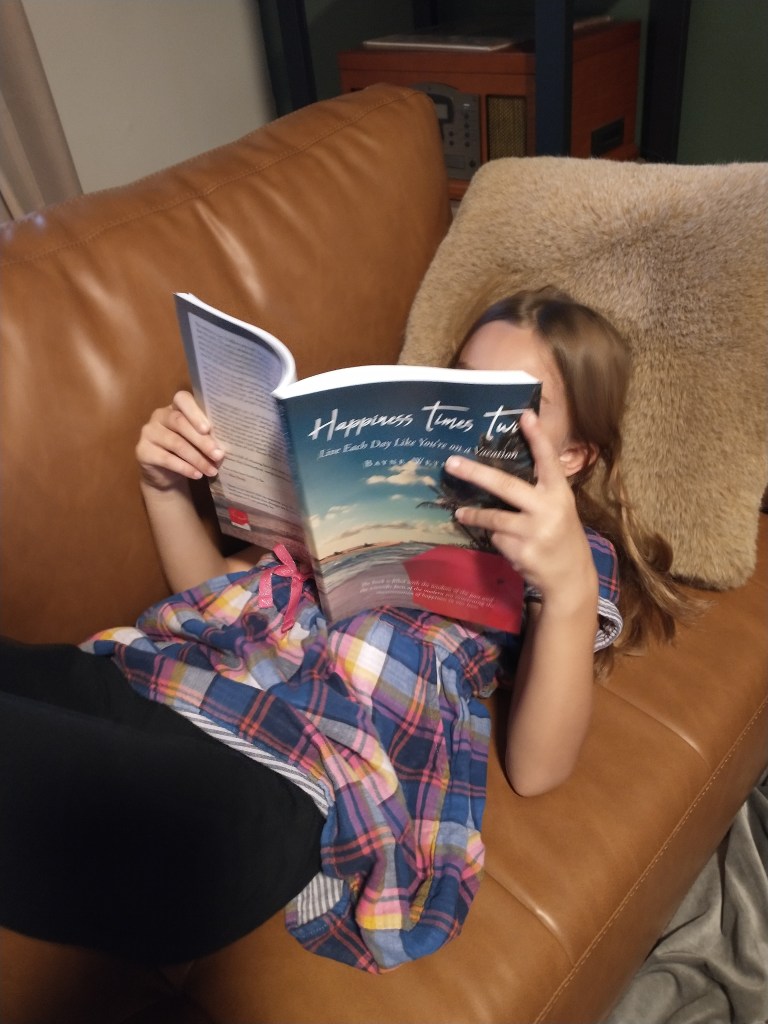
Stole it from me is more like it. There I was sitting at the kitchen table reading the book “Happiness Times Two: Live Each Day Like You’re on Vacation”, and she walks over and starts reading over my shoulder. Buddhism was a funny word and it caught her attention. Not satisfied with her partially obstructed view, she proceeded to take the book out of my hands, laid down on the couch and read it herself. She read a page about The Eightfold Path, or at least moth of page. I think she may have just read the bulleted list of the eight right things over and over again and giggled at the word Buddha a few times. Either way, it is a start. It is an introduction to learning different ideas, and how to use those ideas to be the best person she can. I don’t know if her path is eightfold, but she is on one. Now I need to help her stay on it. Challenge accepted.
My kids are listening. I don’t mean specifically to me, that would be ridiculous. How would the dishwasher get emptied if I didn’t have to remind them five times? I mean in the sense that they are constantly taking in information, some of it intentionally given to them, and some of it they are just absorbing. As a parent, I can mostly control the intentional stuff. I know what I can and can’t say to them, I know what they watch on TV, what they listen to, and what they learn in school. It has become very clear to me that I cannot control what they absorb on their own, and as they get older they are absorbing more than I thought they did. And wouldn’t you know it, kids absorb the darnedest things, like how the president of the United States treats people with dark skin.
I have my political opinions and my beliefs on good governance and effective use of tax dollars, but that isn’t something I talk about with my kids, or even here for that matter. However, my kids (especially my 9 year-old) are old enough to be at least generally aware of the last presidential election. Which I get. I was her age when Clinton was elected the first time, and I remember the debates on TV and being curious to know who my parents were voting for and who was Ross Perot. This year my daughter asked the same thing. Well, the who am I voting for question, not the Ross Perot question. I told her I voted for Harris, and when she asked why I really didn’t get into much of it. To keep it on her level I said something along the lines of how I think she would do a better job and I trusted her to make good choices. She would follow up with flip side and ask why I don’t want to vote for Trump. Again, I would keep it general with something along the lines of how he treats people and that isn’t how a leader should act. Good answers I thought.
That was the information I could control. Clearly there was more absorbed that I could not. On at least a couple occasions my older daughters would come home from school and say something about kids in their class who said their parents voted for Trump. Based on my highly scientific eyeball test of area yard signs, this is not surprising, and at this point I don’t really care. What was more surprising, or maybe eye-opening is a better word, is when they would come home from school and say something about Trump kicking people out of the country if they have darker skin. My kids were absorbing. I am not sure from where, as I doubt this kind of topic was covered as part of phonics – unless they used raid as the example of a long “a” digraph? More likely, a kid heard a thing on the news or around the house and passed it a long in apparently a much deeper playground discussion than I ever got into in school. Sure the Barry Sanders vs. Emmitt Smith debate could get intense, but nobody got deported over it.
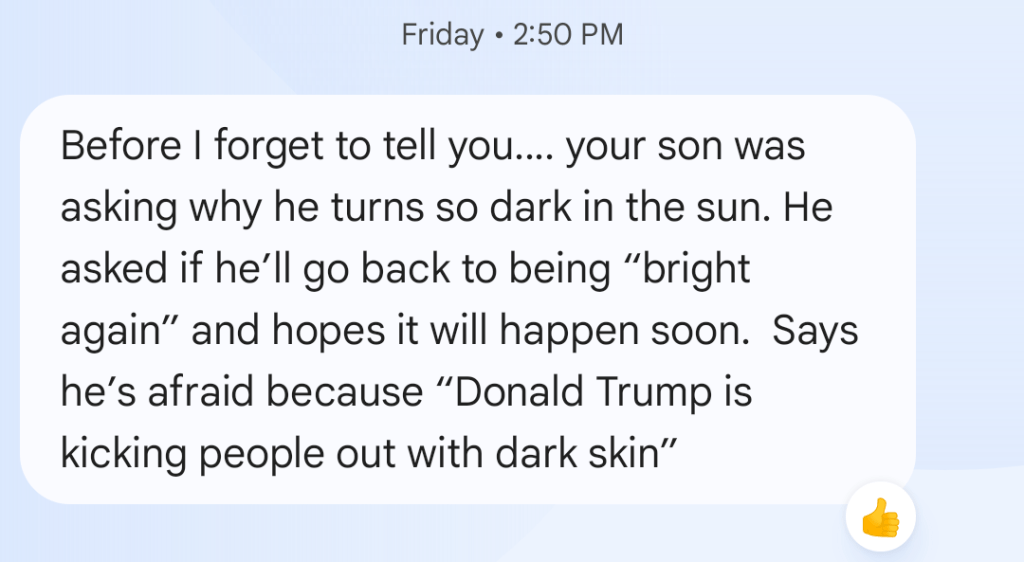
So like a game of telephone, the message got passed down the line from kid to kid getting a little fuzzier around the edges with each retelling, until it reached the point where my 5 year-old son is afraid Trump will kick him out of the country if he gets too tan. Why? Because Trump is kicking darker skinned people out of the country. Pass the SPF 100. And also the constitution. But first the sunscreen. One issue at a time. Specifically, he was asking my wife about getting tan in the Summer, and wondering when he’ll go back to being “bright again.” He doesn’t want to get too dark, lest he be shipped out.
Legal and political accuracy or inaccuracy aside, my son has heard and absorbed enough to form a basic understanding of the situation at hand and applied that to his own life. Which, on one hand is exactly what we want for our kids isn’t? To take in and process information, and then to form their own independent beliefs. Now, I could call into question the reliability of his sources – the messaging passed down from his older sisters – but given the information he had at his disposal and his limited understanding of international politics, I think he pretty much nailed it. Of course on the other hand, of all the things for my son to take in, why does it have to be the racist tendencies of politicians? Sure, I’d like all my kids to be socially aware and consistent voters, but first I’d like them to be more aware of the proper volume to speak at in public and consistent bathers. I wonder if I could infiltrate the playground communication network with rumors that Trump is kicking out kids who don’t shower well enough. Make America lather, rinse, and repeat again.
My son’s fear of being too dark was one opinion he formed and chose to vocalize, but I now wonder what else is rolling around in his head. My kids have asked me many times about why I need to put gas in my truck, perhaps he’s got thoughts on the future of clean energy and the dependence on foreign oil? My daughters know about the war in Ukraine, do they have thoughts on Israel as well? They are starting to spend their own allowance money, so I’m sure they’ll have a take on taxes and tariffs as soon as the price of a squishy ball goes up. Our kids are always paying attention, just not always to things we want them to pay attention to. We can do the best we can to keep what they see and hear as age-appropriate as we can, but we can’t put blinders on them. I want my kids to see what is going on in the world and how it impacts them. Even more so, how it impacts people who aren’t them.
No, my son doesn’t really need to fear getting sent to an El Salvadorian prison for getting tan after a day at the beach. However, he might sit next to somebody in school who legitimately fears for their parents. If what he is hearing now and the opinions he is forming now give him a better sense of understanding and empathy in the future, then I’ll be happy to help him better understand the world he lives in and the people he lives in it with. Parents can’t control all the information our kids take in, but we can do the best we can to help them understand what that information means. Not just for their own good, but for the greater good. That is what separates intelligence from wisdom.
Advancements in technology are, for the most part, great. Take what I am doing right now for example. I’m sitting in a coffee shop using free internet that somehow is beaming its way to my computer. Full transparency, I have no idea how WiFi actually works or what the hell the difference is between any amount of G’s. All I know is that I have a magic machine that puts the world at my fingertips nowhere where my fingertips are in the world. Such is the relationship with technology of somebody who remembers life before the internet. My kids do not have that relationship.
It has been true of every next generation since there have been next generations, but my kids have only known a world with technology that I had to adapt to. I have to believe there were primitive parents out there telling their children that they didn’t always have the wheel. You had to drag the animal carcass back to the fire, it took 13 hours to get there, and that’s how it was and you liked it. The technology changes but the situation is timeless. Also timeless, is the parental idea that your way was better and your kids don’t know what’s good for them. Insert my kid’s relationship with TV, and my relationship with that.
Might as well be hieroglyphics
My kids only know streaming. The idea that a show would only be on a certain day at a specific time that is determined not by them is complete nonsense to them. Telling them that Santa Claus picks what shows people get to watch based on where they rank on the nice list would make more sense to them. (Site Note: that is a genius idea to use to Santa to both manipulate behavior and to limit screen time. Two birds one fanciful stone.) It isn’t like they need to wait for the next episodes of shows to be released either, because for the most part all the shows they watch are several years old. The only new they got into was “Wizards Beyond Waverly Place” and when they watched to the point where the new episodes hadn’t been released yet, I’m pretty sure they thought that was that and they stopped watching. Which brings me to the worst part of how my kids watch TV – they watch a show to death.
Like locusts moving from field to field extracting anything of sustenance or value from the land, my kids move from show to show latching on and devouring every episode over and over until no actual entertainment value remains. For the better part of the last year they have watch, re-watched, and watched again episode after episode of “Wizards of Waverly Place” and “Elena of Avalor.” In a world of nearly endless entertainment options, they watch two shows. Part of me is grateful that despite the vast library of content they have access to, they are content with a small portion. In a way, I appreciate their minimalist tendencies. Though in another way, what the hell is the matter with them? Not only do they watch the same shows over and over again, they watch the same episodes repeatedly. It isn’t like they are cycling through the seasons, they go back and re-watch the same handful of episodes with complete disregard for any plot line that crosses multiple episodes. The idea that shows were meant to be watched in a certain order for the sake of the story making sense is lost on them.
To them, entertainment options are self-contained bits of content. A single song, not an album. A single show, not a season. A single YouTube video, not anything that requires any context at all. If anything, the one they do understand comes in a series devoid of technology – books. Books come in series, and each book has a number. Baby-Sitters Little Sister and Dogman are numbered, and they understand when they have read one of them, they read a different one next. My daughter will spend a considerable amount of time on our library’s website looking for the next book she can request, and will patiently wait days while it is on hold until she can check it out. This is in sharp contrast to the four seconds she spends scrolling through the Disney+ menu until she finds the episode of Wizards where Justin goes on the date and ends up kissing some guy’s belly.
Telling my kids about how I used to watch TV is the new walking to school up hill both ways. A badge of honor for the fortitude that only having seven channels to watch built in me. Though even my example of how good my kids have it is lost on them. They don’t know what a channel is. To them Disney+ is a channel, Hulu is a channel, and PBS Kids is a channel. They only know this because when they ask for a show or movie that isn’t on one of those, I tell them “we don’t get that channel.” That is the only context they have for different sources providing different options. Otherwise, everything they want is always available all the time. I dare not even try to explain the Disney Vault to them, I would only be wasting my breath.
The only hardship of my childhood entertainment that has now been thrust upon my children are commercials. A few months ago we changed from the ad-free Disney+ to having commercials, and oddly enough they seemed to enjoy this novel new disruption in their viewing. They quickly had favorite commercials, and because each ad break usually shows the exact same ads, had them memorized. I’m pretty sure my kids can recite multiple Capital One or Marriott Bonvoy ads word for word. They also view the function of ads differently. I think they think they are supposed to watch them. They will sit and watch the commercials, then ask to pause the show so they can go get a drink or go to the bathroom.
Though, why wouldn’t they just pause the show that everyone is watching because it fits their entertainment need of the moment? They live in a world where content is consumed completely on individual terms. If my daughter doesn’t want to watch what everyone else is watching on TV, she’ll get out a laptop and stream something else. In the same room with headphones on. Just because she doesn’t want to watch Mickey Mouse Clubhouse doesn’t mean she doesn’t want to be part of the group. It seems that is what advances in technology have brought about – being included in the group, yet having your group experience completely customized to your needs.
Well, my wife and I have instructed a new rule to bring back how it was before such individualized entertainment. The kids are only allowed to watch Wizards of Waverly Place on Fridays. In our house, that is now the only day it airs. It took a few Mondays and Tuesdays of reminding, but they caught on. My kids have never been more interested in what day of the week it is. It is summer, so they don’t have the schedule of school to mark the days. Their only point of reference is now being allowed to watch Wizards or not. Technology has taken man from measuring the passage of time with complex arrangement of rocks to viewing Selena Gomez on demand. Somewhere in between kids forgot how to read an analog clock and watch episodic TV in the appropriate manner.
A good apology goes a long way. A bad apology is worse than none at all. An apology from my children is essentially none at all. My kids are terrible at saying they are sorry. An apology from them falls into one of three categories – forced, insincere, or forced and insincere.
For young kids, I get that most apologies are forced. Much like most thank yous, you’re welcomes, and excuse mes, I’m sorry’s are almost all prompted by a “What do you say?” from mom or dad. However, the teaching tool of a gentle prompt has seemed to transform to a cattle prod. Figuratively, of course. Though, note to self – invent kid-safe cattle prod and become billionaire. The Kiddle Prod we’ll call it. Or perhaps the Aprodogy? Patent pending. Anyway, apologies come from force in our house, not from any feelings of guilt, empathy, or regret.
If anything, the apologizer becomes the victim. As if we are the ones inflicting some grievous harm on them by making them admit that they did something they weren’t supposed to do. How dare we make them consider the feelings of another person. Especially when the other person is crying so loudly. I mean, all they did was wack them in the face with a toy, but the other person is the one making a whole thing out of it. So an equal parts forced and annoyed “sorry” gets spat in somebody’s general direction. Then we play the game of “say it like you mean it”, in which now the apology comes off as even more fake and sarcastic because it has been doubly forced. Or triplely forced. Or how many ever times we need to go through this charade until something resembling a real apology is muttered under defeated breath.
However, I find the more annoying terrible apology from my kids to be the one they try to pass off as real but is really just them trying to get out of trouble. They aren’t sorry for what they did, they are sorry they got caught. Whatever the behavior was, they will do it again, and apologize again, and do it again, and apologize again, and so on, and so on. When I told my daughter that I didn’t need her to apologize, that I needed her to not do it again, she took the first half of that to heart. When of course she repeated the behavior, she seemed off-put by the fact I expected her to apologize. “You told me not to,” she said. How quickly she disregarded the second half of my instructions.
I get that giving a real apology can be hard. Even for adults. How many times do you hear the “I’m sorry if…” or “I’d like to apologize,” instead of a real “I’m sorry.” Perhaps my kids are bad at apologizing because it hasn’t been a behavior properly modeled by me, just something I make them say? Not that I am too stubborn or proud to apologize, or even too arrogant to think that I’ve never done anything to apologize for. I just don’t know how many times the situation has come up where I need to give my kids an apology more meaningful than “sorry I at the last cookie.” Which, to be honest, we both know I’m not sorry for.
I just don’t do the kinds of things to my kids that they do to each other which require apologies. The next time I ruin a game of pretend school because I want to be the music teacher but I was the music teacher last time and I never have a turn being a kid and always have to be the teacher or the mom and it isn’t fair that I always make the other kids be students but never give them a chance to be a teacher, will be the first. Also, is it just me, or is there just something odd feeling about a parent apologizing to a kid. I don’t know if it is the power dynamic, or the sense that the parent is always right, but the bar for what a parent needs to apologize for just feels higher. Does it not? Or is that just me and I’ve been glossing over times when I should have said I’m sorry to my kids?
A few days ago a real opportunity came up for a real apology. My daughters were being too silly at bed time – a common source of them only being sorry they got caught – and my 6 year-old daughter was just too wound up. So I went in the room and put her back in bed with something less than great vengeance and furious anger, but enough to really scare and upset her. Honestly, my reaction was overkill. It wasn’t her, it was me. It wasn’t about what was going on in that moment as much as it was the culmination of the five hundred or so other other times that they were doing whatever they wanted to do instead of listening to their parents. She cried herself to sleep. I genuinely felt bad about it. Especially knowing how my daughter is. She is a delicate soul.
Hearing her cry in her bed, part of me wanted to go in there and calm her down and apologize right then. But, part of me wanted to just let it be. She was in bed. They were quiet. Mission accomplished. Sure, with some collateral damage, but accomplished none the less. And what is the better lesson to teach? That if dad is mean he’ll come back and make it ok, or that if you don’t do what dad says he’ll make you cry? Debatable, but I let her, and me, sleep on it.
The next morning I still felt bad about it. While the kids were getting ready for school I called her over, knelt down to her level, and gave her a real apology for reacting the way I did. I asked for hug, and she gave me the biggest hug she may have ever given me. The kind where I would ease up to signal the end (multiple times), but she stayed clung to me. That little peanut is all heart.
She felt better. I felt better. We got on with our days on a positive note, and hopefully I instilled some kind of lesson the proper way to say “I’m sorry.” Now, I say this next part with the disclaimer that I love all my kids equally – differently – but equally, and that they are all great in their own way. However. Naturally, of my three kids, she is the one who needed the lesson in how to apologize the least. Yesterday, my 8-going-on-16-year old daughter gave me an eye roll and a sarcastic thumbs up in place of an apology. Whelp, guess I gotta make her cry now.
Today I abandoned my children. It felt good. I thought I would feel more anxious or guilty about it, but I was really fine with it. And so were they. It was actually their idea.
It is a fine balance to strike between giving your kids what they want and what they need. Usually they aren’t the same thing. At least for my kids anyway. My kids want whatever is easy. Whatever is comfortable. Meeting new people, doing new activities, trying new food, even watching a new TV show is often too much for their comfort zones. So it is often my job to try to get them out of their little bubbles and out into the world where things are new, uncomfortable, and maybe a little dangerous. Not like real danger. Nobody is risking life and limb over here, but maybe going so far as breaking a sweat or skinning a knee.
Are my kids pampered and soft, or have they just become creatures of their comfortable habits? Probably a little of both. So imagine my surprise when all three of them came to me and asked if they could stay home by themselves while I went out to pick up the pizza. My kids, who are too scared to use the bathroom in the basement by themselves, wanted to be left home without adult supervision. Sure, why not.
I don’t know whose idea it was. My 6 year-old daughter came to me with the idea. Not sure if she thought of it or was just the group spokesperson. Of the three kids, she is probably the most brave when it comes to that kind of thing. Home without dad? No problem. Spider somewhere in the general vicinity of someplace she might need to go? Now that’s another story. She was quick to point out that her 8 year-old older sister would be in charge while I was gone. They had a plan. They had a leadership structure in place. Nothing to worry about. Even my 4 year-old son was on board. He who sleeps with a night light that can light the size of a grapefruit has no issues spending some time sans parents.
I asked the oldest if she was ok with it purely out of parental obligation of doing my due diligence. I knew she would be. The appeal of being the person unquestionably in charge dwarfed whatever apprehension she may have about being home alone. I had no doubts that she would run a tight ship in my absence. I didn’t fear for anybody’s safety so much as I did that their chosen leader would become tyrant. Inherent in her first born status is a built in sense of leadership. Well, leadership isn’t always the right word. Is “sense-of-in-chargeness” a word? Well, it is now. Make no mistake, even when my wife and I are home, when the three kids are together it is not a cheerocracy.
They were fine with it, so I left. It was nice. It was freeing – for all of us. I got out the door and in the car in record time. No reminding anybody fifteen times to get their shoes on. No hoisting kids in the truck. No waiting while each kids takes their turn fumbling with their seat belt. A quick trip was truly just that. Really. The Domino’s we ordered from is only *checks Google Maps* .6 miles from our house. Which did play a major role in me letting them stay home. Yes, I want to push my kids to be self sufficient and not fear what may happen if I’m not in the next room, but I’m not a reckless parent. I’m not going to leave them for hours while I go enjoy a couple of beers or something. Not yet anyway.
I was gone and back before they probably even had time to enjoy themselves that much. When I got back they were playing school in the living room, which is exactly what they would have done if I was home with them. Which was nice to see. There has been a trend of sneaky behavior lately, so I was happy to see they weren’t locked in one of their bedrooms or all in the bathroom at the same time for some odd reason they can’t explain. Because that’s a thing kids do. The little weirdos. They were just playing school. The younger two having story time. The oldest basking in her in chargeness.
Even though it was only a few minutes, I could tell they got a kick out of it. And I could really tell my oldest was proud of herself. Sure, its not like she did anything incredibly brave like go downstairs to the basement at night, but this was big for her. Unlike all the times when she put herself in charge, this time she really was a leader. She asked if she could do it again. I told her yes, for things like short trips to the store, picking up food, picking up somebody from school, stuff like that. I made sure to point out that for something like Mommy and Daddy going out on a date at night that we would still need to get a babysitter. She immediately and completely agreed. Clearly she wanted the responsibility, but not that much.
Eight seems like reasonable age to start giving that kind of responsible independence in small doses. I mean, Kevin McCallister was eight when he got left home alone. And my kids aren’t really alone, they have each other. It’s not like I’m asking them to fight off a team of thieves for an entire weekend, just to not do anything that will require a trip to urgent care or let any strangers in the house while I’m getting some food. Perfectly within the realm of third grade responsibility. Pizza is a half mile away, grocery store is one mile away, coffee shop is right down the street. I can give my kids a taste of self management and push them out of their comfort zone one snack at a time. And last I checked there hasn’t been a string of break-ins and flooded homes in the area. I don’t live in a gated community or anything, but the closest registered sex offender is *checks Michigan sex offender registry* seven houses down the street…sonofabitch I’m never leaving them home again.
There are some things that I’ll never forget – birthdays, home run totals, movie quotes. On the flip side, there are some things I can never remember – passwords, when was the time I changed the furnace filter, what my wife said is for dinner tomorrow. Generally, I tend to remember the stuff that is important to me. One of the challenges that comes with having kids is not just remembering my important stuff, but having to remember their stuff too. Realistically, one human brain can only remember so many people’s stuff. Something is bound to fall through the cracks, but probably something minor and easy to forget. Something like, oh let’s say, sending your kids school.
We’ve got three kids in two different schools, so our calendar of who has what on what days isn’t consistent for everybody. Drop-off times, pick-up times, half-days, days off, and spring break are usually not the same. Even something as seemingly universal like Christmas break is never exactly the same. Throw your non-school related stuff on top of that like doctors appointments and after school activities, and a well organized calendar is a must. We’ve very much come to rely on our calendar to tell us what to do on any given day. However, we recently ran into a problem we never anticipated – what if the calendar is wrong?
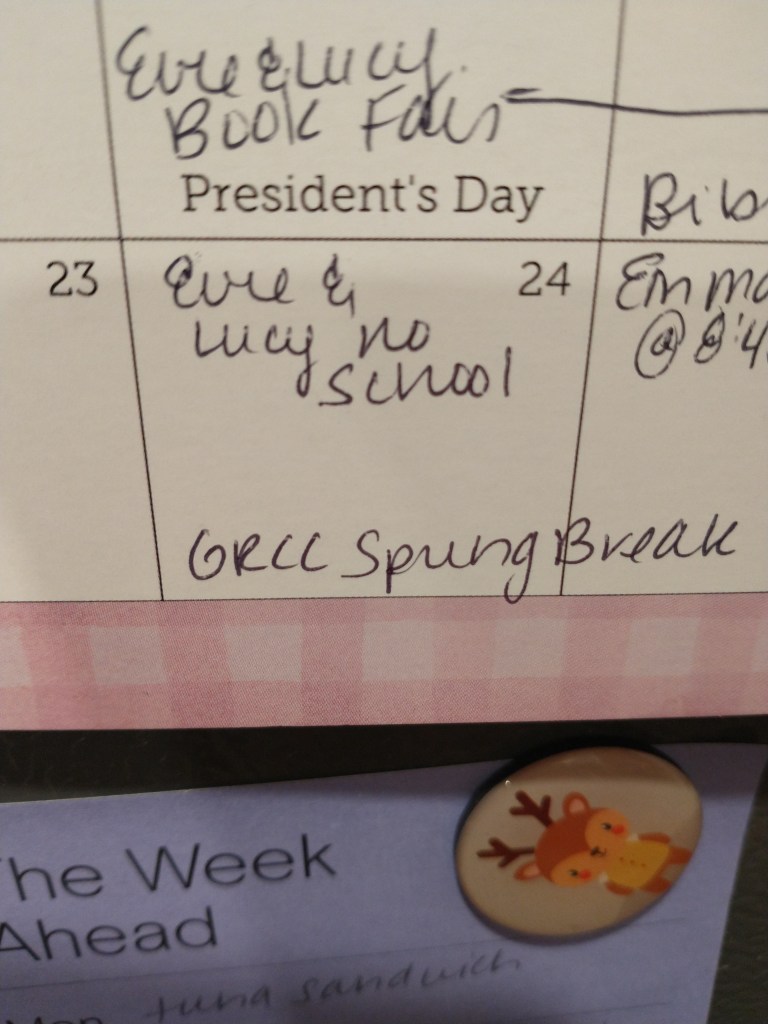
A few weeks ago my son had his mid-winter break, which was a four-day weekend. His older sisters, who go to a different school, had their mid-winter break last week. It was also marked on the calendar as a four-day weekend. It was marked on the calendar so it must be true. One school wouldn’t give a different numbers of days than another, and and calendar wouldn’t lie to me. Would it? Turns out yes, yes it would.
After a lovely weekend, I went back to work on Monday morning and my daughters stayed home to soak in their (alleged) day off. My wife works for a college, so she was also home for her own spring break (which in no way aligns with either of the kids’ schools’ spring breaks, so that’s fun). Shortly before noon, I checked my email and saw I had something from the girls’ school with the subject line “Student Absent.” How odd that they would send that email on a scheduled off day. Must be a mistake. It has happened before where they have sent out district-wide alerts on on accident. Must be one of those. I opened the email expecting to see some kind of generic statement that didn’t apply to be, but oddly enough to this email had my daughter’s name in it. Huh.
I wish you weren’t a liar.
I checked the calendar, the household source of truth, to make sure. There it was, written in on Monday “Evie and Lucy No School.” Surely, the school would send a follow up email apologizing for the mistake any moment now. Then I noticed the email actual came about an hour ago. Odd it would take them this long to send the correction. To be extra sure, I asked my wife about it. She checked the all-knowing calendar, and I wasn’t seeing things, “Evie and Lucy No School” as still there. So it is written, so it shall be. No?
What’s going on here? Did the school district not check my calendar? We checked the district’s last weekly newsletter. Was this the first time I looked at it? Yes. Should I have looked at it before? Who’s to say? I suddenly miss the days of a stack of papers coming home in a folder. An email is easy to ignore, a bright red piece of paper my kid thrusts at me will at least have a three day life span of sitting on the counter in a pile of junk mail and old pizza coupons waiting to be put in the recycling bin. Anyway, the newsletter had the previous Friday listed as a day off, but not Monday. Odd that my calendar would be right but the newsletter be wrong. I mean, it’s almost like the calendar was wrong, but that couldn’t happen. If we can’t trust the calendar, what can we trust? What else on there was wrong? What else didn’t I show up for? Was it even Monday? Is today my birthday? I can’t believe anything anymore.
I sent a very embarrassing reply to the absentee notice. Pretty sure the school administrator felt bad holding parental stupidity against my kids and said she would mark it as an excused absence. Perhaps she took pity on me. Perhaps her calendar had led her astray at some point and knows what it feels like. I mean, we can’t be the first parents to not send their kids to school because they didn’t know if they actually did have school that day or not. Ya know, when I say it that way it almost sounds like it was our fault and not the calendar’s. No, that can’t be it. Stupid calendar.








 I Think Therefore I Dad